
Zora Health / Employer guide / Chile
Support employees through fertility treatment, and keep the talent you have invested in.
Fertility treatment rarely fits around a work calendar, and most employees go through it quietly, often while doing some of their best work. Zora Health helps you build practical fertility support, from policies and manager guidance to confidential care navigation and access to 128+ partner clinics in 16 countries, around your workforce and budget. Companies including Hilton, LinkedIn, Sanofi, HSBC, Mastercard, Carousell and Singapore Management University work with us.
Book an employer consultation Explore the cost calculator
Five things Chilean HR leaders should know
- Chile’s total fertility rate fell to 0.99 in 2025, the first time below one child per woman, with 146,446 births (INE provisional figures).
- FONASA funds IVF and IUI free in public hospitals, with limited yearly places, or through fixed-price PAD bonos at private centres, paying about half of IVF.
- Isapres must cover IVF at least at FONASA’s PAD amounts (Superintendencia de Salud, 2019). Chile has no assisted reproduction law; egg freezing is mostly paid privately.
- Maternity leave is 18 weeks plus 12 weeks of postnatal parental leave; paternity leave is 5 days; there is no statutory fertility leave.
- A fixed allowance for PAD co-payments, private cycles and egg freezing keeps the budget predictable.
Why fertility is a business problem for employers
Fertility treatment does not fit around a work calendar. A clinic sets the date of a scan the day before. Egg collection happens when the body is ready, usually about 36 hours after a final trigger injection. Then comes a two-week wait, and for many couples, another cycle. Your team feels it: missed meetings, unexplained absences, a strong performer who suddenly goes quiet.
About 1 in 6 people worldwide are affected by infertility (WHO). We found no Chilean survey on fertility treatment at work. In Carrot‘s 2023 survey of 5,000 people in 5 countries, 79% were uncomfortable discussing fertility at work; in Ferring‘s 2025 survey of more than 3,600 people in 5 countries, 60% were not clearly entitled to time off for appointments.
- Resignations. 39% of Ferring’s respondents in treatment had left or were considering leaving their job.
- Lower performance. 55% of Carrot’s respondents said fertility challenges had hurt their work performance.
- Long waits for public places. An informal, non-representative online form of 66 patients found average waits of 1 year 7 months for PAD treatment and 2 years 7 months in public hospitals; FONASA says it has no waiting list (CIPER, February 2026).
- Unequal access by region. The 15 PAD providers are in 5 regions; 11 regions have none (CIPER). In July 2026, the Senate Health Committee asked the Ministry of Health to change access criteria criticised for excluding single and lesbian women (Diario Constitucional).
What employers gain
Keep the people you spent the most to develop
Replacing an employee costs one-half to two times annual salary (Gallup). In the Latin American Registry’s 2019 data, 41.5% of IVF and ICSI cycles with a woman’s own eggs were at ages 35 to 39 and 32.9% at 40 or over (RLA), the years many women reach senior roles.
Stand out in a tight labour market
In Ferring’s survey, 73% of people with fertility challenges said they would be attracted to a role that offers fertility support, and 65% of Carrot’s respondents said they would change jobs for fertility benefits. In February 2023, Walmart Chile described a plan paying 50% of treatment or egg freezing for 40 employees a year, and Mercado Libre said it had paid 70% of egg retrieval since 2018, once, up to US$5,000 (Meganoticias, February 2023).
Make fertility support financially predictable
Aon projected a gross medical trend rate of 7.5% for employer health plans in Chile in 2026, against expected inflation of 3.2%. A capped allowance gives finance a fixed number in pesos.
Zora helps employers structure benefits around local costs and the gaps in FONASA and isapre cover, within an agreed budget.
Want to see what this would look like for your Chilean workforce?
What IVF costs, and what the state pays
Employees use FONASA, the public insurer, or a private isapre (FONASA).
| Item | Typical cost (CLP) | Notes |
|---|---|---|
| IVF, one private cycle, Santiago | 4,000,000 to 6,000,000 | ICSI: 5,000,000 to 8,000,000, medication included (CuántoMeCuesta, May 2026); Clínica CER quotes from 6,000,000 for isapre patients (October 2026) |
| Egg donation, anonymous donor | 7,000,000 to 12,000,000 | CuántoMeCuesta, May 2026 |
| IVF through PAD bonos, patient co-payment | 1,903,720 for stages 1 to 4; 2,181,750 for all 8 bonos | Universidad de Valparaíso clinic, 2026 PAD budget; FIV Santiago 2026 list, where the 8 bonos total 4,363,550 |
| Elective egg freezing | 2,450,000 plus medication of about 1,500,000 to 2,500,000 | SGFertility, Santiago, including storage to year 5, then about 378,000 a year (page updated February 2026) |
| Embryo storage, per year | 300,000 to 500,000 | Paid by the patient |
Sources: CuántoMeCuesta, May 2026 (secondary, Santiago clinics); Clínica CER, October 2026; Universidad de Valparaíso PAD budget 2026; FIV Santiago 2026; SGFertility.
| Item | Public support (or own savings) | What the employee still carries |
|---|---|---|
| IVF or IUI in a public hospital (FONASA) | Zero co-payment | A wait for one of the limited yearly places |
| IVF or IUI by PAD bono (FONASA groups B, C and D) | A fixed contribution: about 50% for IVF; Canal 13 reported about 53% for IUI | The fixed co-payment per stage, over CLP 2 million for a full IVF cycle. |
| IVF with an isapre | At least FONASA’s PAD amount | The rest of the clinic price |
| Donor eggs, donor sperm, surrogacy | None in FONASA; own savings | The full private cost |
| Egg freezing | Not covered by FONASA; some isapre plans pay up to about 30%, according to specialists | Most of the cost, plus storage |
Sources: FONASA; FONASA PAD tariff 2026; ChileAtiende; Canal 13, October 2025; CIPER, February 2026; Circular IF/331, 2019; IF/388, 2021; El Mostrador, July 2025.
Age is one of the strongest predictors of IVF success. Chile publishes no national success rates by age; in the Latin American Registry’s 2022 data (16 countries, 11 Chilean centres), the delivery rate per fresh IVF or ICSI transfer with own eggs was 30.6% after elective single-embryo transfer and 14.2% after non-elective single-embryo transfer, all ages combined (RLA 2022).
FONASA sets no fixed age cut-off; ovarian reserve tests take precedence over age, which in practice can exclude older women (FONASA, La Tercera). Many patients need more than one transfer, so the size and timing of an allowance matter.
Give Employees Access to Fertility Specialists
Help employees navigate fertility care with access to doctors and clinics, treatment information, and clear guidance on IVF, egg freezing and other fertility options. Employees can explore their options privately, without needing to go through HR.
Fertility support that fits your workforce and budget
You do not need to overhaul your existing health insurance to support employees through fertility treatment. Start with awareness and manager education, add confidential one-to-one support, or introduce a funded allowance across your offices. There is no minimum company size.
Where included in the employer programme, eligible employees can use talks and care navigation without paying Zora a separate fee. Care navigation allowances are set in each proposal. Treatment and other third-party costs are paid separately, either by employees or through the fertility allowance their employer provides.
Companies starting the conversation
Essentials
Expert-led talks for employees and managers, fertility and menopause policy templates, manager guides and full access to the Zora app. Up to 2 talks a year.
Employees supported one to one
Navigation
Everything in Essentials, plus confidential one-to-one care navigation and access to our partner clinic network.
Large and multi-country teams
Complete
Everything in Navigation, plus quarterly anonymised reporting, a dedicated account manager and scheduled review meetings with HR.
Optional add-ons can be added to any programme, subject to availability: hormone and fertility diagnostics and telehealth with specialists. Pricing is tailored to your headcount, your countries and the services you choose. Most companies start with a single talk.
Request a proposal See how Zora works for employers
Comparing fertility benefit providers? Use our RFP question bank
Our RFP question bank has 40 questions, with why each one matters, what a good answer looks like and a scoring sheet for three providers. Six of the questions for Chile:
- Are local-plan employees covered, or only staff on international health plans?
- Do you require an infertility diagnosis before support starts?
- How does the allowance work alongside FONASA PAD bonos and isapre cover, and do you help employees claim what their plan must pay before using company funds?
- Which clinics can employees use in Santiago, Valparaíso, Concepción and Antofagasta, and how do you support staff in regions with no PAD provider?
- Can single employees, same-sex couples and employees who need donor eggs use the programme, given that FONASA criteria and cover exclude some of them?
- How is employee health data handled under Law 19.628 and Law 21.719, which treats health data as sensitive, and what does the employer see?
Your download link appears here as soon as you submit. Zora Health may contact you about employee benefits; see our privacy policy.
Plan your fertility benefit budget
Fertility benefit budget planner
Model the annual claims budget for a fertility allowance. Change any number.
This is a claims budget, not a Zora quotation. Zora’s programme fees, implementation and optional services are separate.
Illustration only. Utilisation is an editable assumption, not observed Zora data. The calculation assumes each user claims their full annual allowance, and excludes programme fees and setup costs. For a tailored model, request an employer proposal.
Estimate the potential workforce impact of fertility challenges
A rough planning scenario. It applies a global infertility estimate to your headcount, so it is not a prediction for your workforce, a measured loss or a forecast of savings from any programme.
Range: CLP 112,750,000 to CLP 319,000,000 a year, depending on replacement cost.
Assumptions: infertility affects about 1 in 6 adults (World Health Organization, 2023), applied to employees aged 25 to 44. Replacing an employee costs one-half to two times their annual salary (Gallup, 2019); the headline uses the low end. Absence is valued at salary divided by 250 working days. Exit rate and days lost are your own assumptions.
This is a hypothetical cost scenario, not a prediction of actual employee departures, an estimate of Zora’s financial impact or a guaranteed saving from fertility benefits.
Already have corporate health insurance? Here is where Zora fits
Your medical plan may cover some consultations and tests, but fertility treatment is often limited or excluded, so check your policy wording. Employees still need to understand their options, the public funding they qualify for and which clinic suits them.
Zora works alongside your existing insurance and benefits. We help employees get reliable information, navigate their care options and reach suitable specialists, and we give HR manager guidance, policy templates and, on the Complete programme, anonymised reporting. You strengthen fertility support without replacing your medical plan.
How Zora works
For your employees
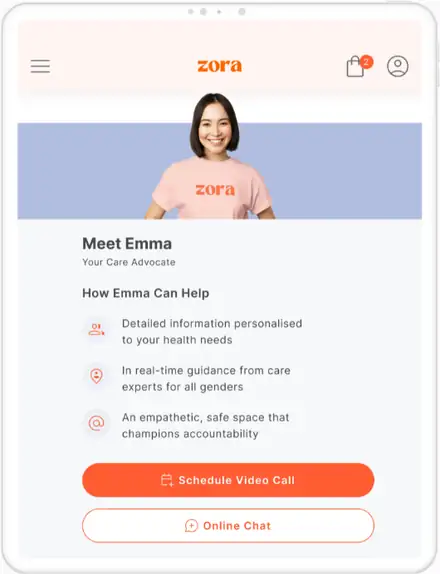
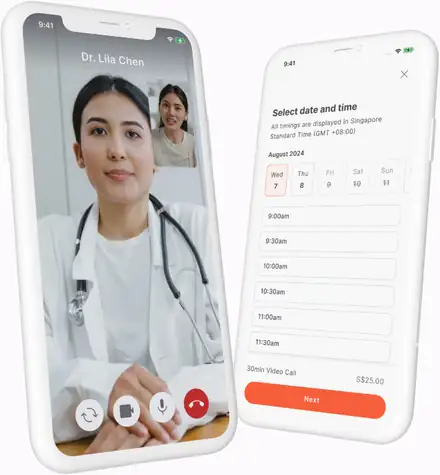
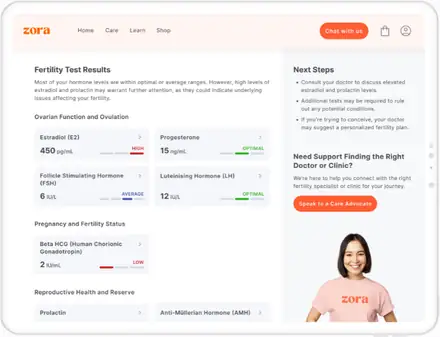
Employees join the Zora app with a company code, or single sign-on for larger teams. They can learn about fertility and egg freezing, understand what your benefit covers, book a confidential care navigation call and find partner clinics and specialists.
For HR
- Kick-off, week 1. Agree goals, countries and which employees are eligible.
- Policy and benefit design, weeks 2 to 4. Draft or update your fertility policy using our templates.
- Launch, typically weeks 4 to 6. A launch talk for employees and managers, plus a communications pack for HR to send.
- Live support. Employees book care navigation calls and use the Zora app.
- Reporting, every 3 months, on the Complete programme. Anonymised usage, common themes and our recommendations, reviewed with your account manager.
Privacy
Employee privacy is central to our programmes. On the Complete programme, routine employer reports contain aggregated engagement and utilisation information, with safeguards to prevent identification of individual employees. On every programme, personal health information is not included in standard HR reporting, and employees can get help without telling their manager. Where eligibility checks or claims administration need individual-level data, access is limited to authorised parties for defined purposes, as agreed in writing before launch. Employee data is handled in line with Singapore’s Personal Data Protection Act and Chile’s Personal Data Protection Law (Law 19.628, as amended by Law 21.719), which treats health data as sensitive data.
Clinics and doctors in Chile
Zora’s clinic and doctor directory does not list providers in Chile yet. It lists 421 clinics and 1,185 doctors across 25 countries, mostly in Asia Pacific and the Middle East (browse clinics or browse doctors). Employees in Chile can still use Zora’s education and the Zora app. Ask us how your team in Chile would use Zora before you launch. See Zora’s employer guides for every country.
Rules and eligibility in Chile
Who can use assisted reproduction
Chile has no comprehensive law on assisted reproduction. A bill the then president promised in June 2025 (Emol) had not been submitted by December 2025, according to patient groups (CIPER). In January 2025, 13 senators asked the president to sponsor a law treating infertility as a disease (24 Horas). Two narrower bills on infertility prevention and information, 16.708-11 and 16.709-11, passed the Senate and got simple urgency in June 2026 (Ministry of Health, La Tercera); in August 2026 both were still in the Chamber of Deputies (Parlamento.ai). A bill to ban and criminalise surrogacy, 17.337-07, was approved in general in January 2026, and in June 2026 the Chamber of Deputies’ Family Committee approved its criminal provisions, including prison terms and making surrogacy contracts void; it is not law (Diario Constitucional, June 2026).
How public and private cover work
PAD bonos require FONASA group B, C or D, an infertility diagnosis, an ovarian reserve assessment and a referral; FONASA funds up to 2 IVF cycles (FONASA). Since 11 February 2019, isapres must cover the 8 PAD groups for IVF at least at FONASA’s amounts, excluding embryo storage (Circular IF/331); low-complexity treatment followed in 2021 (Circular IF/388).
Mostly private, with no statutory rules
FONASA covers embryo freezing within IVF, not elective egg vitrification. Specialists told El Mostrador in July 2025 that a bill widening cover for preventive egg freezing had passed the Senate. For cancer patients, the GES guarantee covers sperm freezing for men with testicular cancer but not egg freezing for women (Vergara 240, UDP journalism school, July 2026). We found no law setting an age limit or storage period.
Leave and pregnancy protection
Maternity leave is 6 weeks before birth and 12 after (article 195). Postnatal parental leave adds 12 weeks, or 18 weeks part-time, and the mother can transfer weeks to the father from the seventh week (article 197 bis). Fathers get 5 paid days within the first month (article 195). Job protection runs from pregnancy until one year after maternity leave ends (article 201). There is no statutory fertility leave.
Harassment, discrimination and health data
The Ley Karin (Law 21.643), in force since 1 August 2024, requires a harassment prevention protocol and investigations completed within 30 days, free of arbitrary distinctions such as sex or maternity (Subsecretaría de Previsión Social). Law 21.719 of December 2024 treats health data as sensitive, needing explicit consent (Colegio Médico). It takes effect on 1 December 2026 unless a bill the Senate passed by 33 votes to 6 on 28 October 2026, moving the date to 15 October 2027, becomes law first; the bill returned to the Chamber of Deputies, which had not voted on it by early November 2026 (Diario Financiero, October 2026, Pauta, Boostify).
Why employers choose Zora
Companies including Hilton, LinkedIn, Sanofi, HSBC, Mastercard, Carousell and Singapore Management University work with Zora Health. We work alongside your existing insurance, helping employees use the cover they already have and find suitable specialists based on their needs.
Trying to conceive with a heavy workload took a toll on my husband and me. It helped us understand our options.
Questions HR teams ask us
Is fertility leave mandatory in Chile?
No. We found no statutory fertility or IVF leave in Chile. The Labour Code gives 18 weeks of maternity leave (6 before birth and 12 after), 12 weeks of postnatal parental leave that the mother can partly transfer to the father, and 5 days of paternity leave. Time off for treatment depends on company policy or a medical licence.
Does FONASA pay for IVF?
Yes, in two ways. Public hospitals provide low- and high-complexity treatment with zero co-payment but a limited number of places each year. Members in FONASA groups B, C and D with an infertility diagnosis can instead buy PAD bonos at private centres in FONASA’s network, where FONASA pays a fixed share, about 50% for IVF, and the patient pays a fixed co-payment, about CLP 2.2 million for a full IVF cycle in 2026. FONASA funds up to 2 IVF cycles. Donor gametes, surrogacy and embryo storage are not covered. Isapres must cover IVF at least at FONASA’s PAD amounts.
Can employees freeze their eggs in Chile?
Yes, privately. FONASA does not cover elective egg vitrification, and specialists say isapre cover reaches at most about 30%. SGFertility in Santiago lists CLP 2,450,000 per cycle including 5 years of storage, plus about CLP 1,500,000 to 2,500,000 for medication. We found no law setting an age limit or storage period.
Does Zora replace our health insurance?
No. Zora works alongside your insurance. We help employees understand their options, find suitable specialists and use the cover they already have.
How much does a fertility benefit cost an employer?
It depends on the allowance, eligibility and expected uptake. Use the budget planner on this page for a first estimate, then ask us for a tailored proposal based on your headcount and countries.
How quickly can we launch?
Typically 4 to 6 weeks from contract to launch, depending on scope and countries. Most companies start with a single talk.
Related guides for Chilean employers
Build a fertility benefit for your team
Whether you are introducing fertility benefits for the first time or improving an existing programme, tell us your headcount, countries and priorities. We will come back within two working days with suitable services, an indicative budget and a practical rollout plan for your Chilean team. No obligation.
Not ready to talk yet? Explore how Zora works
Sources
- Bloomberg Línea, Chile registró la tasa de fecundidad más baja de su historia en 2025 (INE provisional figures), 28 May 2026
- ChileAtiende, Programa de fertilización asistida de baja y alta complejidad de Fonasa
- CIPER Chile, reportaje on FONASA fertility treatment, co-payments and waits, 26 February 2026
- Canal 13, Bono PAD de Fonasa ya cubre tratamientos de fertilidad, 23 October 2025
- Diario Constitucional, Comisión de Salud conoce propuestas para revertir la baja natalidad, 12 July 2026
- Ministry of Health, Ministra May Chomali anuncia urgencia a proyectos sobre fertilidad, 17 June 2026
- La Tercera, Gobierno da urgencia simple a proyectos que promueven la fertilidad, June 2026
- Superintendencia de Salud, Circular IF/331 on isapre cover of high-complexity assisted reproduction, 27 August 2019
- Superintendencia de Salud, Circular IF/388 on assisted reproduction in isapre plans, 17 August 2021
- El Mostrador, Cuánto cuesta congelar óvulos en Chile: precios, cobertura y desafíos pendientes, 17 July 2025
- Universidad de Valparaíso, Centro de Reproducción Humana, Presupuesto FIV PAD 2026
- CuántoMeCuesta, Fertilización in vitro en Chile, prices updated May 2026
- La Tercera, A qué edad se puede realizar una fertilización in vitro
- Latin American Registry of Assisted Reproduction (RLA), ART in Latin America 2021, JBRA Assisted Reproduction 2025
- Latin American Registry of Assisted Reproduction (RLA), ART in Latin America 2022, JBRA Assisted Reproduction 2026
- Latin American Registry of Assisted Reproduction (RLA), ART in Latin America 2019, JBRA Assisted Reproduction 2022
- Emol, Legisladoras buscan fusionar proyectos de fertilidad asistida, 8 June 2025
- CIPER Chile, Sobre una ley que garantice la reproducción asistida (letter), 9 December 2025
- 24 Horas, Senadoras solicitan al presidente Boric que patrocine la ley integral de infertilidad, 23 January 2025
- DerechoPedia, Labour Code article 195
- DerechoPedia, Labour Code article 197 bis
- DerechoPedia, Labour Code article 201
- Subsecretaría de Previsión Social, Guía Ley Karin (Law 21.643), August 2024
- Colegio Médico de Chile, Protección de datos en el sector salud (Law 21.719), April 2026
- Pauta, Senado aprueba prórroga de ley de datos personales, 29 October 2026
- Aon, The Global Medical Trend Rates Report 2026, October 2025 (PDF copy hosted by Consultorsalud)
- INE, Encuesta Nacional de Empleo, July to September 2026, 29 October 2026
- Meganoticias, Empresas en Chile que financian tratamientos de fertilidad a sus trabajadoras, 1 February 2023
- FONASA, Programa especial de Fertilización Asistida
- FONASA, Transferencia embrionaria en tratamiento de fertilización asistida de alta complejidad (PAD, arancel 2026)
- FIV Santiago, Precios PAD fertilización asistida, actualizado 2026
- SGFertility, Costos de vitrificar óvulos (page updated February 2026)
- Clínica CER, Cuánto cuesta un tratamiento de fertilidad en Chile: precios 2026, 14 October 2026
- Vergara 240 (Escuela de Periodismo UDP), El privilegio de preservar: la brecha de género en la fertilidad de pacientes con cáncer, 15 July 2026
- Diario Constitucional, Aprueban sanciones penales para la maternidad subrogada (Boletín 17.337-07), 18 June 2026
- Parlamento.ai, Tres meses de agenda sanitaria en el Congreso, May to August 2026
- Boostify, ¿Se posterga la Ley 21.719 a 2027? Estado del proyecto, updated 29 October 2026
- Diario Financiero, Senate approves changes to the bill postponing the personal data protection law, 28 October 2026
- Ferring Pharmaceuticals, Fertility Matters at Work and This Can Happen, workplace fertility survey, November 2025
- Carrot Fertility, Global Fertility at Work report, 2023
- Gallup, This fixable problem costs US businesses $1 trillion, 2019
- World Health Organization, 1 in 6 people globally affected by infertility, April 2023
Information on this page is correct as of 5 November 2026. Laws, public funding, insurance rules and treatment costs change often, so check current rules with the relevant authority, insurer or a qualified adviser before making decisions. This page is general information, not legal, financial, tax or medical advice.