
Zora Health / Employer guide / Croatia
Support employees through fertility treatment, and keep the talent you have invested in.
Fertility treatment rarely fits around a work calendar, and most employees go through it quietly, often while doing some of their best work. Zora Health helps you build practical fertility support, from policies and manager guidance to confidential care navigation and access to 128+ partner clinics in 16 countries, around your workforce and budget. Companies including Hilton, LinkedIn, Sanofi, HSBC, Mastercard, Carousell and Singapore Management University work with us.
Book an employer consultation Explore the cost calculator
Five things Croatian HR leaders should know
- Croatia’s total fertility rate was 1.46 in 2024, above the EU average of 1.34, and 1,869 children were born after assisted reproduction in 2023 at 18 authorised centres.
- Under the 2012 Medically Assisted Fertilisation Act, the state insurer HZZO pays for 4 inseminations and 6 IVF attempts, 2 of them in a natural cycle, generally until the woman turns 42.
- Treatment is open to married and cohabiting different-sex couples, and to single women when infertility treatment has failed or has no prospect of success. Surrogacy is prohibited, donation is unpaid, and a donor-conceived child can see the donor’s identity at 18.
- Maternity leave runs to 6 months at 100% of pay with no cap, and since 1 March 2025 fathers get 20 working days of paternity leave at full pay. There is no statutory fertility leave.
- A fixed annual allowance can cover what HZZO leaves out, such as attempts beyond the funded limit, treatment after 42, private clinic fees and time off.
Why fertility is a business problem for employers
Fertility treatment does not fit around a work calendar. A clinic sets the date of a scan the day before. Egg collection happens when the body is ready, usually about 36 hours after a final trigger injection. Then comes a two-week wait, and for many couples, another cycle. Your team feels it: missed meetings, unexplained absences, a strong performer who suddenly goes quiet.
About 1 in 6 people worldwide are affected by infertility (World Health Organization). In Croatia, 5,336 couples and women had medically assisted reproduction in 2023 (Ministry of Health, 2023 annual report), and Professor Velimir Šimunić puts the average age of women having IVF at 37.5 (Novi list, September 2025). We found no Croatian survey on fertility at work. In Carrot’s 2023 survey of 5,000 people in Canada, India, Mexico, the UK and the US, 79% felt uncomfortable discussing fertility at work (Carrot).
- Resignations. 39% of employees with fertility challenges had left or were considering leaving their job during treatment, in Ferring’s 2025 survey of more than 3,600 employees and employers in Australia, France, Japan, Poland and the UK (Ferring).
- Lower performance. 55% of respondents in the same Carrot survey said fertility challenges had hurt their work performance (Carrot).
- Pregnancy after IVF at work. In Jurčić v. Croatia (4 February 2021), the European Court of Human Rights found that HZZO’s refusal to register a newly hired woman as an insured employee, because she had just had IVF and was pregnant, was direct sex discrimination (Strasbourg Observers).
- Unequal access. No domestic donor programme operates, so patients who need donor eggs or sperm go abroad (Korać Graovac, 2024; Novi list, September 2025), and the parents’ association Roda says patients in Rijeka and Split have less access than those in Zagreb (Novi list, February 2026).
What employers gain
Keep the people you spent the most to develop
Replacing an employee costs one-half to two times their annual salary, according to Gallup. 69.4% of Croatian women aged 15 to 64 were in the labour force in 2025 (Croatian Bureau of Statistics), so treatment often falls in the years when careers build. A written policy, paid time off and a funded allowance can reduce those exits.
Stand out in a tight labour market
73% of employees with fertility challenges would be attracted to an employer offering fertility support, in the same Ferring survey (Ferring). 65% in the Carrot survey said they would change jobs for fertility benefits (Carrot). We found no published example of a Croatian employer funding fertility treatment.
Make fertility support financially predictable
Employers can set annual or lifetime allowances and choose which treatments qualify, including drugs in private cycles.
Zora helps employers structure benefits around local treatment costs and HZZO funding rules, so HR can run the programme within an agreed budget.
Want to see what this would look like for your Croatian workforce?
What IVF costs, and what the state pays
Patients outside the HZZO-funded limits pay the clinic. KB Merkur in Zagreb publishes its self-pay prices.
| Item | Price (EUR) | Notes |
|---|---|---|
| IVF or ICSI within HZZO limits | 0 | For insured patients who meet the legal conditions |
| Self-pay IVF or ICSI, stimulated cycle, KB Merkur | 793 to 1,394 | Short or conventional protocol, with or without embryo freezing; drugs extra |
| Self-pay IVF or ICSI, natural cycle, KB Merkur | 773 to 855 | Drugs extra |
| Private IVF, stimulated cycle, Poliklinika Šparac, Split | 1,500 (1,670 with ICSI) | Cash price, without drugs, with 3 years of cryopreservation |
| Embryo storage beyond 5 years | 133 a year | KB Merkur |
Sources: KB Merkur, MPO price list in EUR, uploaded May 2025; Poliklinika Šparac price list, revised 28 January 2026. Prices vary by clinic and protocol.
| Item | Public support (or own savings) | What the employee still carries |
|---|---|---|
| Intrauterine insemination | 4 HZZO-funded attempts | Time off for appointments |
| IVF, generally until the woman turns 42 | 6 HZZO-funded attempts, 2 of them in a natural cycle; a doctor may approve treatment after 42 for particularly justified health reasons | Time off, travel to a centre, and any cycles beyond the limit |
| Storage of surplus embryos and eggs | HZZO pays for up to 5 years | Storage fees after 5 years |
| Donor eggs or sperm | No domestic donor programme; HZZO funds treatment abroad when donor gametes are needed, according to Professor Pavičić Baldani | Travel and time away from work |
| Egg freezing without a medical reason | None; own savings | The full cost |
Sources: Medically Assisted Fertilisation Act, NN 86/12, articles 7, 10 and 34; KB Merkur, patient leaflet on legal conditions, dated June 2020; Novi list, September 2025 (treatment abroad with donor gametes, as reported; we did not find the HZZO rule itself); Jurić, University of Rijeka thesis, 2022 (social egg freezing is self-funded).
Age is one of the strongest predictors of IVF success, alongside individual medical and treatment factors. In 2023, deliveries per embryo transfer were 32.25% for women aged 34 or under, 26.44% at 35 to 39 and 12.16% at 40 or over, across all Croatian centres (Ministry of Health, annual MPO report for 2023).
Clinical pregnancy rates per transfer were 37.94%, 32.50% and 16.36%.
Give Employees Access to Fertility Specialists
Help employees navigate fertility care with access to doctors and clinics, treatment information, and clear guidance on IVF, egg freezing and other fertility options. Employees can explore their options privately, without needing to go through HR.
Fertility support that fits your workforce and budget
You do not need to overhaul your existing health insurance to support employees through fertility treatment. Start with awareness and manager education, add confidential one-to-one support, or introduce a funded allowance across your offices. There is no minimum company size.
Where included in the employer programme, eligible employees can use talks and care navigation without paying Zora a separate fee. Care navigation allowances are set in each proposal. Treatment and other third-party costs are paid separately, either by employees or through the fertility allowance their employer provides.
Companies starting the conversation
Essentials
Expert-led talks for employees and managers, fertility and menopause policy templates, manager guides and full access to the Zora app. Up to 2 talks a year.
Employees supported one to one
Navigation
Everything in Essentials, plus confidential one-to-one care navigation and access to our partner clinic network.
Large and multi-country teams
Complete
Everything in Navigation, plus quarterly anonymised reporting, a dedicated account manager and scheduled review meetings with HR.
Optional add-ons can be added to any programme, subject to availability: hormone and fertility diagnostics and telehealth with specialists. Pricing is tailored to your headcount, your countries and the services you choose. Most companies start with a single talk.
Request a proposal See how Zora works for employers
Comparing fertility benefit providers? Use our RFP question bank
Our RFP question bank has 40 questions, with why each one matters, what a good answer looks like and a scoring sheet for three providers. Six of the questions for Croatia:
- Are local-plan employees covered, or only staff on international health plans?
- Do you require an infertility diagnosis before support starts?
- How does the allowance sit alongside HZZO funding, so employees use their 4 funded inseminations and 6 funded IVF attempts first and claim extra cycles, treatment after 42 and private fees from the allowance?
- Which public and private centres in Zagreb, Split, Rijeka and Osijek do you work with, and how do you support employees outside Zagreb?
- How do you support employees whose treatment needs donor eggs or sperm, given there is no domestic donor programme and treatment abroad is involved?
- How do you handle health data as special category data under the GDPR and Croatia’s Act on the Implementation of the GDPR, and what will the employer see?
Your download link appears here as soon as you submit. Zora Health may contact you about employee benefits; see our privacy policy.
Plan your fertility benefit budget
Fertility benefit budget planner
Model the annual claims budget for a fertility allowance. Change any number.
This is a claims budget, not a Zora quotation. Zora’s programme fees, implementation and optional services are separate.
Illustration only. Utilisation is an editable assumption, not observed Zora data. The calculation assumes each user claims their full annual allowance, and excludes programme fees and setup costs. For a tailored model, request an employer proposal.
Estimate the potential workforce impact of fertility challenges
A rough planning scenario. It applies a global infertility estimate to your headcount, so it is not a prediction for your workforce, a measured loss or a forecast of savings from any programme.
Range: €112,750 to €319,000 a year, depending on replacement cost.
Assumptions: infertility affects about 1 in 6 adults (World Health Organization, 2023), applied to employees aged 25 to 44. Replacing an employee costs one-half to two times their annual salary (Gallup, 2019); the headline uses the low end. Absence is valued at salary divided by 250 working days. Exit rate and days lost are your own assumptions.
This is a hypothetical cost scenario, not a prediction of actual employee departures, an estimate of Zora’s financial impact or a guaranteed saving from fertility benefits.
Already have corporate health insurance? Here is where Zora fits
Your medical plan may cover some consultations and tests, but fertility treatment is often limited or excluded, so check your policy wording. Employees still need to understand their options, the public funding they qualify for and which clinic suits them.
Zora works alongside your existing insurance and benefits. We help employees get reliable information, navigate their care options and reach suitable specialists, and we give HR manager guidance, policy templates and, on the Complete programme, anonymised reporting. You strengthen fertility support without replacing your medical plan.
How Zora works
For your employees
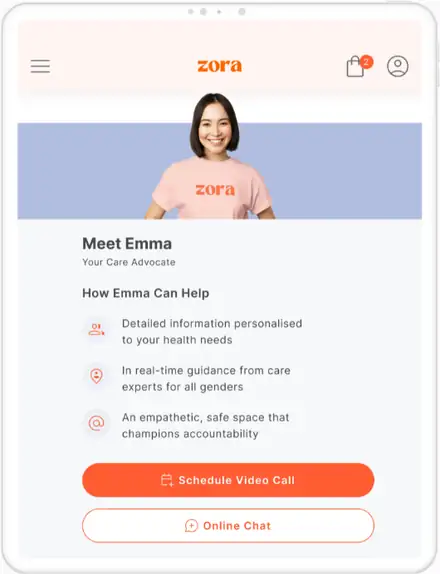
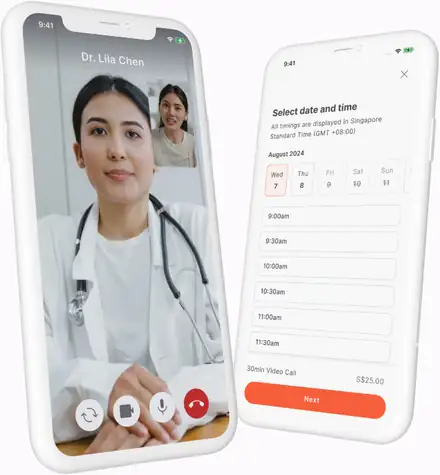
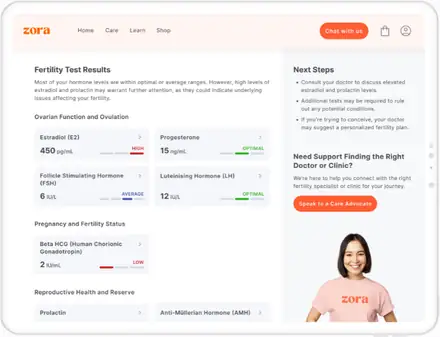
Employees join the Zora app with a company code, or single sign-on for larger teams. They can learn about fertility and egg freezing, understand what your benefit covers, book a confidential care navigation call and find partner clinics and specialists.
For HR
- Kick-off, week 1. Agree goals, countries and which employees are eligible.
- Policy and benefit design, weeks 2 to 4. Draft or update your fertility policy using our templates.
- Launch, typically weeks 4 to 6. A launch talk for employees and managers, plus a communications pack for HR to send.
- Live support. Employees book care navigation calls and use the Zora app.
- Reporting, every 3 months, on the Complete programme. Anonymised usage, common themes and our recommendations, reviewed with your account manager.
Privacy
Employee privacy is central to our programmes. On the Complete programme, routine employer reports contain aggregated engagement and utilisation information, with safeguards to prevent identification of individual employees. On every programme, personal health information is not included in standard HR reporting, and employees can get help without telling their manager. Where eligibility checks or claims administration need individual-level data, access is limited to authorised parties for defined purposes, as agreed in writing before launch. Employee data is handled in line with Singapore’s Personal Data Protection Act and Croatia’s application of the EU General Data Protection Regulation (GDPR) and the Act on the Implementation of the General Data Protection Regulation (NN 42/18), which treat health data as special category data.
Clinics and doctors in Croatia
Zora’s clinic and doctor directory does not list providers in Croatia yet. It lists 421 clinics and 1,185 doctors across 25 countries, mostly in Asia Pacific and the Middle East (browse clinics or browse doctors). Employees in Croatia can still use Zora’s education and the Zora app. Ask us how your team in Croatia would use Zora before you launch. See Zora’s employer guides for every country.
Rules and eligibility in Croatia
Who can use assisted reproduction
Article 10 gives the right to an adult woman and man who are married or living in a cohabiting partnership. A single adult woman also qualifies if earlier infertility treatment was unsuccessful or had no prospect of success (Medically Assisted Fertilisation Act). The single-woman route excludes a woman living in a same-sex union, so female couples do not qualify. Surrogacy is prohibited and agreements for it are void (Act, articles 10 and 31).
Donation rules and egg freezing
Egg, sperm and embryo donation is allowed, unpaid apart from necessary costs, and limited to 3 children per donor. Donors are not told the family’s identity; a child aged 18 may see the donor’s details in the state register. Article 34 allows people whose fertility is at risk for health reasons to freeze eggs, sperm or tissue for their own later use, generally for 5 years with one 5-year extension (Act, articles 15, 19, 21, 26, 33 and 34).
Maternity, paternity and parental leave
Maternity leave runs until the child is 6 months old, with 28 days before to 70 days after birth compulsory, and pays 100% of the pay basis with no cap, subject to prior insurance. Since 1 March 2025, paternity leave is 20 working days (30 for twins or more) at 100% with no cap, up from 10. Each parent then has 4 months of parental leave, 2 of them non-transferable, paid at 100% up to EUR 3,001.79 a month (HZZO; Moja firma, February 2026).
Discrimination protection
The Anti-Discrimination Act covers sex, marital or family status, health and sexual orientation, among other grounds, and applies to hiring, working conditions and promotion (Anti-Discrimination Act, articles 1 and 8).
Funding unchanged, access debated
We found no amendment to the Act or to HZZO funding between 2024 and November 2026; in May 2026 the government rejected an opposition interpellation and defended the current rules (Index.hr, May 2026). In June 2024, opposition MP Anka Mrak Taritaš said she would again propose access for all women, including women in same-sex partnerships (Novi list, June 2024). In February 2026, the chair of the National Commission for MPO, Dinka Pavičić Baldani, opposed proposals to raise the age limit (Novi list, February 2026).
Why employers choose Zora
Companies including Hilton, LinkedIn, Sanofi, HSBC, Mastercard, Carousell and Singapore Management University work with Zora Health. We work alongside your existing insurance, helping employees use the cover they already have and find suitable specialists based on their needs.
Trying to conceive with a heavy workload took a toll on my husband and me. It helped us understand our options.
Questions HR teams ask us
Is fertility leave mandatory in Croatia?
No. Croatian law has no fertility or IVF leave, so paid time off for appointments depends on the employer’s policy. The Anti-Discrimination Act covers sex, health and marital or family status, and in Jurčić v. Croatia (2021) the European Court of Human Rights found that treating a woman less favourably because she was having IVF and became pregnant was sex discrimination.
Does HZZO pay for IVF in Croatia?
Yes. Under the 2012 Medically Assisted Fertilisation Act, HZZO pays for 4 intrauterine inseminations and 6 IVF attempts, 2 of them in a natural cycle, generally until the woman turns 42. A doctor may approve treatment after 42 for particularly justified health reasons. HZZO also pays to store surplus embryos and eggs for up to 5 years.
Can single women or employees who want to freeze their eggs get treatment in Croatia?
A single adult woman can have treatment if earlier infertility treatment was unsuccessful or had no prospect of success. The Act provides for egg freezing where fertility is at risk for health reasons, such as before cancer treatment. A 2022 University of Rijeka thesis says egg freezing for social reasons is paid by the patient; we found no official guidance on it, so employees should confirm with the clinic.
Does Zora replace our health insurance?
No. Zora works alongside your insurance. We help employees understand their options, find suitable specialists and use the cover they already have.
How much does a fertility benefit cost an employer?
It depends on the allowance, eligibility and expected uptake. Use the budget planner on this page for a first estimate, then ask us for a tailored proposal based on your headcount and countries.
How quickly can we launch?
Typically 4 to 6 weeks from contract to launch, depending on scope and countries. Most companies start with a single talk.
Related guides for Croatian employers
Build a fertility benefit for your team
Whether you are introducing fertility benefits for the first time or improving an existing programme, tell us your headcount, countries and priorities. We will come back within two working days with suitable services, an indicative budget and a practical rollout plan for your Croatian team. No obligation.
Not ready to talk yet? Explore how Zora works
Sources
- Eurostat, Total fertility rate (tps00199), Croatia
- Euronews, Europe’s fertility rates keep falling, 14 March 2026
- Croatian Bureau of Statistics, Natural change in population, 2025, 17 July 2026
- Ministry of Health, Godišnje izvješće o MPO aktivnostima za 2023. (annual MPO report for 2023), published 2026
- Zakon o medicinski pomognutoj oplodnji (Medically Assisted Fertilisation Act), NN 86/12, zakon.hr
- KB Merkur, Zakonski uvjeti i dokumentacija za MPO (patient leaflet), dated 1 June 2020
- KB Merkur, Cjenik MPO EUR (price list), uploaded May 2025
- Poliklinika Šparac, Cjenik neplodnost (price list), revised 28 January 2026
- Novi list, Udvostručen broj Hrvata začetih potpomognutom oplodnjom, 11 February 2026
- Novi list, U Opatiju došla Louise Joy Brown (Velimir Šimunić and Dinka Pavičić Baldani quoted), 13 September 2025
- Novi list, Mrak Taritaš announces amendments to the MPO Act, 27 June 2024
- Index.hr (Hina), Vlada odbila interpelaciju Anke Mrak Taritaš o reproduktivnim pravima žena, 21 May 2026
- Korać Graovac, A., Pravno uređenje medicinski pomognute oplodnje i njezin utjecaj na obitelj, Glasnik HKLD, 2024
- N1, Daily: Croatia plans to import sperm and egg cells from EU, 29 May 2023
- HZZO, Rodiljne i roditeljske potpore i rodiljni i roditeljski dopusti (copy hosted by IEF), 2025
- Moja firma, Rodiljni i roditeljski dopust 2026: prava, trajanje i naknade, February 2026
- tportal, Ministar otkrio detalje novih demografskih mjera, 21 November 2024
- Zakon o suzbijanju diskriminacije (Anti-Discrimination Act), NN 85/08, 112/12, zakon.hr
- Strasbourg Observers, Jurčić v. Croatia: clarity on protecting women undergoing IVF treatment from discrimination, March 2021
- White and Case, GDPR guide to national implementation: Croatia
- General Data Protection Regulation, Article 9
- Croatian Bureau of Statistics, Labour force in the Republic of Croatia, 2025 annual average, 14 April 2026
- Jurić, N., Liječenje medicinski pomognutom oplodnjom nakon kriopohrane jajnih stanica, master’s thesis, University of Rijeka, 2022
- Ferring Pharmaceuticals, Fertility Matters at Work and This Can Happen, workplace fertility survey, November 2025
- Carrot Fertility, Global Fertility at Work report, 2023
- Gallup, This fixable problem costs US businesses $1 trillion, 2019
- World Health Organization, 1 in 6 people globally affected by infertility, April 2023
Information on this page is correct as of 5 November 2026. Laws, public funding, insurance rules and treatment costs change often, so check current rules with the relevant authority, insurer or a qualified adviser before making decisions. This page is general information, not legal, financial, tax or medical advice.