
Zora Health / Employer guide / India
Support employees through fertility treatment, and keep the talent you have invested in.
Fertility treatment rarely fits around a work calendar, and most employees go through it quietly, often while doing some of their best work. Zora Health helps you build practical fertility support, from policies and manager guidance to confidential care navigation and access to 128+ partner clinics in 16 countries, around your workforce and budget. Companies including Hilton, LinkedIn, Sanofi, HSBC, Mastercard, Carousell and Singapore Management University work with us.
Book an employer consultation Explore the cost calculator
Five things India HR leaders should know
- Standard Indian health policies exclude assisted reproduction: IRDAI’s standard exclusion wording (Excl17) lists IVF, ICSI, GIFT and ZIFT, and the retail riders and women’s plans we reviewed cap IVF at ₹1 lakh to ₹3 lakh after waiting periods of 2 to 3 years.
- The health ministry told Parliament in August 2024 that about 14 to 16% of eligible couples are affected by infertility, and India’s total fertility rate was 1.9 in 2024 (Sample Registration System).
- Under the ART (Regulation) Act 2021, clinics may treat women above 21 and below 50, and men above 21 and below 55. Single women can use ART; the Act gives no route to single men or same-sex couples.
- Under the Code on Social Security 2020, in force since 21 November 2025, maternity benefit is 26 weeks, or 12 weeks for a woman with two or more surviving children. Adopting and commissioning mothers receive 12 weeks. There is no statutory fertility or IVF leave.
- Aon projects Indian employer medical costs to rise 10.1% in 2027, after 11.5% in 2026, so a fixed annual allowance keeps a fertility budget predictable while insurance sub-limits stay small.
Why fertility is a business problem for employers
Fertility treatment does not fit around a work calendar. A clinic sets the date of a scan the day before. Egg collection happens when the body is ready, usually about 36 hours after a final trigger injection. Then comes a two-week wait, and for many couples, another cycle. Your team feels it: missed meetings, unexplained absences, a strong performer who suddenly goes quiet.
We found no India-specific survey on hiding fertility treatment at work. The closest is Carrot Fertility’s 2023 survey of 5,000 people in Canada, India, Mexico, the UK and the US: 79% felt uncomfortable discussing fertility openly at work, mainly because it could be seen as unprofessional.
- Resignations. In Ferring’s 2025 survey of more than 3,600 employees and employers in Australia, France, Japan, Poland and the UK, 39% of employees with fertility challenges had left or were considering leaving their role during treatment.
- Lower performance. In the same Carrot 2023 survey, 55% said fertility challenges had hurt their work performance.
- Cost carried by the employee. Insurer guides put a private IVF cycle at about ₹1 lakh to ₹4 lakh (Tata AIG), and standard health policies exclude assisted reproduction, so most employees pay from their own savings.
- Uneven access. In August 2024 the health ministry listed 9 government hospitals with IVF facilities, including AIIMS New Delhi and PGIMER Chandigarh.
What employers gain
Keep the people you spent the most to develop
Replacing an employee costs one-half to two times their annual salary, according to Gallup. A written policy, paid time off and a funded allowance can help address barriers that contribute to employee attrition.
Stand out in a tight labour market
In the Carrot 2023 survey (Canada, India, Mexico, the UK and the US), 65% said they would change jobs to work for a company that offers fertility benefits. Some employers in India have already moved: in 2023, P&G India announced cover for IUI and IVF costs, including outpatient expenses, for employees and their partners, and in late 2023 Merck India launched a fertility programme with financial support capped at ₹10 lakh.
Make fertility support financially predictable
A fertility benefit does not need to mean unlimited medical coverage. Employers can set annual or lifetime allowances, decide which treatments qualify, and provide guidance and education so employees understand their options before they spend.
Zora helps employers structure benefits around local treatment costs, the law and workforce needs, so HR can run the programme within an agreed budget.
Want to see what this would look like for your India workforce?
What IVF costs, and what the state pays
We could not verify any national public funding scheme for IVF or egg freezing in India. Most treatment is private. IRDAI’s standard exclusion wording for health insurance (code Excl17, amended February 2020) lists sterility and infertility expenses, including assisted reproduction such as IVF, ZIFT, GIFT and ICSI, and gestational surrogacy.
| Item | Typical cost | Notes |
|---|---|---|
| IVF cycle, private clinic | ₹1 lakh to ₹4 lakh | Range quoted by Tata AIG and Coverfox; many patients need more than one cycle |
| First IVF cycle at a top clinic | About ₹2.5 lakh | OneAssure example, 2026 |
| Tests, scans and consultations before a procedure | About ₹50,000 | OneAssure; often paid out of pocket without an outpatient (OPD) rider |
| Egg freezing | No verified published figure | Ask clinics for itemised quotes that include medication and yearly storage |
Sources: Tata AIG, Coverfox, Freo, OneAssure, 2026. These are insurer and broker estimates. The ART Act does not regulate treatment prices (Indian Fertility Society, July 2025).
| Item | Public support (or own savings) | What the employee still carries |
|---|---|---|
| IVF, standard health policy | None: excluded under Excl17. A small number of government hospitals offer IVF | Full private cost, typically ₹1 lakh to ₹4 lakh per cycle |
| IVF with a retail rider or women’s plan | Insurance, not a subsidy. Care Classic: up to ₹2 lakh per policy year after 36 months, once every 3 years, with a sum insured of ₹5 lakh or more. Bajaj Allianz HERizon Care: motherhood cover of ₹1, 2 or 3 lakh, with ART claims once per lifetime after 24 months | Everything above the sub-limit, plus premiums and the waiting period |
| Egg freezing | Own savings (not a subsidy) | Full cost of stimulation, retrieval and storage |
Sources: IRDAI circular IRDAI/HLT/REG/CIR/046/02/2020; plan limits as summarised by Freo (check current policy wordings with each insurer); government IVF hospitals from a Lok Sabha answer, 2 August 2024.
Age is one of the strongest predictors of IVF success, alongside individual medical and treatment factors. India has no published national success rates by age: in August 2024 the health ministry told the Lok Sabha that data on the costs and success rates of fertility centres is not maintained centrally.
The ART Act also sets an upper limit of 50 for women receiving treatment (section 21(g)), so an employee who delays treatment because of cost has a fixed legal window, which is why the size of an allowance, and when employees can use it, matter as much as whether you offer one.
Give Employees Access to Fertility Specialists Across Asia
Help employees navigate fertility care with access to doctors and clinics, treatment information, and clear guidance on IVF, egg freezing and other fertility options. Employees can explore their options privately, without needing to go through HR.
Fertility clinics in India on the Zora app include Pristyn Care Fertility, Birla Fertility & IVF Center and Nova IVF Fertility Centre Chennai.
Fertility support that fits your workforce and budget
You do not need to overhaul your existing health insurance to support employees through fertility treatment. Start with awareness and manager education, add confidential one-to-one support, or introduce a funded allowance across your offices. There is no minimum company size.
Where included in the employer programme, eligible employees can use talks and care navigation without paying Zora a separate fee. Care navigation allowances are set in each proposal. Treatment and other third-party costs are paid separately, either by employees or through the fertility allowance their employer provides.
Companies starting the conversation
Essentials
Expert-led talks for employees and managers, fertility and menopause policy templates, manager guides and full access to the Zora app. Up to 2 talks a year.
Employees supported one to one
Navigation
Everything in Essentials, plus confidential one-to-one care navigation and access to our partner clinic network.
Large teams across Asia
Complete
Everything in Navigation, plus quarterly anonymised reporting, a dedicated account manager and scheduled review meetings with HR.
Optional add-ons can be added to any programme, subject to availability: hormone and fertility diagnostics and telehealth with specialists. Pricing is tailored to your headcount, your countries and the services you choose. Most companies start with a single talk.
Request a proposal See how Zora works for employers
Comparing fertility benefit providers? Use our RFP question bank
Most RFP templates were written for the US. Ours has 40 questions written for Asia, with why each one matters, what a good answer looks like and a scoring sheet for three providers. Six of the questions for India:
- Are local-plan employees covered, or only staff on international health plans?
- Do you require an infertility diagnosis before support starts?
- Which of your partner clinics are registered under the ART (Regulation) Act, and in which cities (for example Mumbai, Delhi NCR, Bengaluru, Hyderabad, Chennai and Pune)?
- How does the allowance work alongside our group health policy, any IVF sub-limits and the Excl17 infertility exclusion, so employees are not paid twice or left with gaps?
- How do you apply the ART and Surrogacy Acts’ age and marital-status rules, and what support do you give employees who are not eligible for treatment in India?
- How is employees’ fertility data collected, stored and shared under the Digital Personal Data Protection Act 2023 and 2025 Rules, and what does HR see?
Your download link appears here as soon as you submit. Zora Health may contact you about employee benefits; see our privacy policy.
Plan your fertility benefit budget
Fertility benefit budget planner
Model the annual claims budget for a fertility allowance. Change any number.
This is a claims budget, not a Zora quotation. Zora’s programme fees, implementation and optional services are separate.
Illustration only. Utilisation is an editable assumption, not observed Zora data. The calculation assumes each user claims their full annual allowance, and excludes programme fees and setup costs. For a tailored model, request an employer proposal.
Estimate the potential workforce impact of fertility challenges
A rough planning scenario. It applies a global infertility estimate to your headcount, so it is not a prediction for your workforce, a measured loss or a forecast of savings from any programme.
Range: ₹5,637,500 to ₹15,950,000 a year, depending on replacement cost.
Assumptions: infertility affects about 1 in 6 adults (World Health Organization, 2023), applied to employees aged 25 to 44. Replacing an employee costs one-half to two times their annual salary (Gallup, 2019); the headline uses the low end. Absence is valued at salary divided by 250 working days. Exit rate and days lost are your own assumptions.
This is a hypothetical cost scenario, not a prediction of actual employee departures, an estimate of Zora’s financial impact or a guaranteed saving from fertility benefits.
Already have corporate health insurance? Here is where Zora fits
Your medical plan may cover some consultations and tests, but fertility treatment is often limited or excluded, so check your policy wording. Employees still need to understand their options, the public funding they qualify for and which clinic suits them.
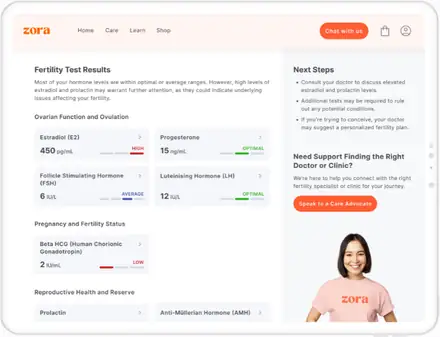
Zora works alongside your existing insurance and benefits. We help employees get reliable information, navigate their care options and reach suitable specialists, and we give HR manager guidance, policy templates and, on the Complete programme, anonymised reporting. You strengthen fertility support without replacing your medical plan.
How Zora works
For your employees
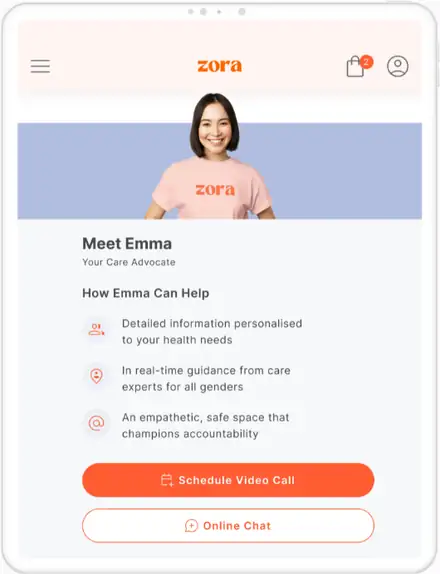
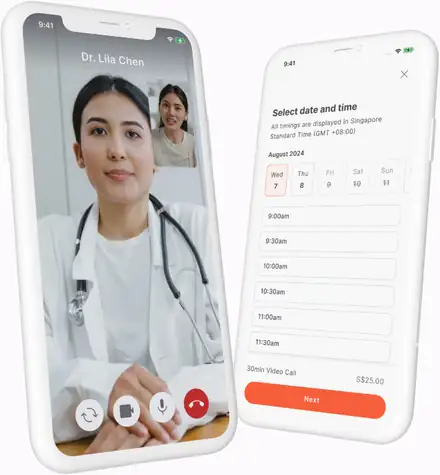
Employees join the Zora app with a company code, or single sign-on for larger teams. They can learn about fertility and egg freezing, understand what your benefit covers, book a confidential care navigation call and find partner clinics and specialists.
For HR
- Kick-off, week 1. Agree goals, countries and which employees are eligible.
- Policy and benefit design, weeks 2 to 4. Draft or update your fertility policy using our templates.
- Launch, typically weeks 4 to 6. A launch talk for employees and managers, plus a communications pack for HR to send.
- Live support. Employees book care navigation calls and use the Zora app.
- Reporting, every 3 months, on the Complete programme. Anonymised usage, common themes and our recommendations, reviewed with your account manager.
Privacy
Employee privacy is central to our programmes. On the Complete programme, routine employer reports contain aggregated engagement and utilisation information, with safeguards to prevent identification of individual employees. On every programme, personal health information is not included in standard HR reporting, and employees can get help without telling their manager. Where eligibility checks or claims administration need individual-level data, access is limited to authorised parties for defined purposes, as agreed in writing before launch. Employee data is handled in line with Singapore’s Personal Data Protection Act and India’s Digital Personal Data Protection Act 2023 and 2025 Rules.
Clinics and doctors in India
Zora’s directory lists 43 clinics and 61 doctors in India. Locations include Bengaluru, Hyderabad and New Delhi. Of these clinics, 39 list IVF and 30 list egg freezing.
Employees can browse clinics in India, see IVF clinics and find a doctor in India on the Zora app. The directory is for information only and is not an endorsement. See Zora’s employer guides for every country.
Rules and eligibility in India
Who can use assisted reproduction
It defines a commissioning couple as an infertile married couple, and a woman as any woman above 21 who approaches a clinic, with no marital-status condition (section 2). Clinics may treat women above 21 and below 50, and men above 21 and below 55 (section 21(g)). The definitions give no route to single men, or to same-sex couples as a couple (ClearIAS).
Allowed at registered clinics, with consent rules
The Act has no separate provision on elective egg freezing; clinics apply the general age limits. Clinics may not cryopreserve gametes or embryos without written instructions and consent from all parties, donor gametes and embryos may be stored for no more than 10 years, and moving your own gametes or embryos for personal use needs National Board permission (sections 22, 28 and 29). Ask legal counsel before setting eligibility rules for egg freezing.
Surrogacy is altruistic and limited by age and marital status
Intending couples must be married, with the wife aged 23 to 50 and the husband 26 to 55 (NewsBytes). Widowed or divorced women aged 35 to 45 may use surrogacy with their own eggs and donor sperm. The 2024 amendment rules allow a married couple to use a donor gamete if a District Medical Board certifies a medical need, reversing a 2023 ban (Vision IAS, Shankar IAS). On 9 October 2025, in Arun Muthuvel v Union of India, the Supreme Court held that the age limits do not apply to couples who had frozen embryos before the Act came into force on 25 January 2022 (LiveLaw, Dhyeya IAS). The Court did not rule on whether the age limits themselves are valid (NewsBytes).
26 weeks of maternity benefit, no fertility leave
The four Labour Codes, which consolidate 29 central labour laws, took effect on 21 November 2025 and prohibit gender discrimination (PIB). Maternity benefit, previously under the Maternity Benefit Act 1961, now sits in Chapter VI of the Code on Social Security 2020. Under section 60, a woman with at least 80 days of work in the previous 12 months receives up to 26 weeks of paid maternity benefit, with no more than 8 weeks before delivery; a woman with two or more surviving children receives 12 weeks (King Stubb & Kasiva).
Adopting mothers and commissioning mothers receive 12 weeks from the date the child is handed over. On 17 March 2026, in Hamsaanandini Nanduri v Union of India, the Supreme Court struck down the rule limiting adoption benefit to children under three months (Down To Earth). There is no statutory fertility leave; in 2024, Bizongo added leave and financial support for IVF and egg freezing regardless of marital status.
New consent and breach rules for employee data
The Digital Personal Data Protection Rules 2025 were notified on 14 November 2025, giving effect to the 2023 Act with an 18-month phased compliance period (PIB). The consent manager rules apply from 13 November 2026 and most obligations from 13 May 2027 (King Stubb & Kasiva, August 2026). From then, data fiduciaries, including employers, must give a separate, plain-language consent notice stating each purpose and tell affected people of a breach without delay. The government consulted in 2026 on shortening the timeline, so check the current deadlines with counsel.
Why employers choose Zora
Companies including Hilton, LinkedIn, Sanofi, HSBC, Mastercard, Carousell and Singapore Management University work with Zora Health. We work alongside your existing insurance, helping employees use the cover they already have and find suitable specialists based on their needs.
Trying to conceive with a heavy workload took a toll on my husband and me. It helped us understand our options.
Questions HR teams ask us
Is fertility leave mandatory in India?
No. Indian law does not require fertility or IVF leave. Under the Code on Social Security 2020, maternity benefit is 26 weeks, or 12 weeks for a woman with two or more surviving children, and adopting and commissioning mothers receive 12 weeks. Some employers add fertility leave voluntarily: in 2024, Bizongo added leave for IVF and egg freezing.
Does health insurance in India cover IVF?
Usually not. IRDAI’s standard exclusion wording (Excl17) lists assisted reproduction such as IVF and ICSI. Some insurers sell riders or women’s health plans that pay a capped amount: the plans we reviewed pay ₹1 lakh to ₹3 lakh after a waiting period of 2 to 3 years, and some brokers report waits of up to 6 years. Group policies can be negotiated, so check your own policy wording.
Can single women use IVF or freeze their eggs in India?
The ART (Regulation) Act 2021 allows clinics to treat a woman above 21 and below 50 without a marital-status condition, so single women can use ART at registered clinics. The Act has no separate section on elective egg freezing, and donor gametes and embryos can be stored for no more than 10 years. Employers should take legal advice before setting eligibility rules.
Does Zora replace our health insurance?
No. Zora works alongside your insurance. We help employees understand their options, find suitable specialists and use the cover they already have.
How much does a fertility benefit cost an employer?
It depends on the allowance, eligibility and expected uptake. Use the budget planner on this page for a first estimate, then ask us for a tailored proposal based on your headcount and countries.
How quickly can we launch?
Typically 4 to 6 weeks from contract to launch, depending on scope and countries. Most companies start with a single talk.
Related guides for India employers
Build a fertility benefit for your team
Whether you are introducing fertility benefits for the first time or improving an existing programme, tell us your headcount, countries and priorities. We will come back within two working days with suitable services, an indicative budget and a practical rollout plan for your India team. No obligation.
Not ready to talk yet? Explore how Zora works
Sources
- Office of the Registrar General and Census Commissioner, India, Sample Registration System Statistical Report 2024, May 2026
- Lok Sabha Unstarred Question 1963, Infertility Among Young Generation, Ministry of Health and Family Welfare, 2 August 2024
- Ministry of Health and Family Welfare, National ART and Surrogacy Portal, registration statistics (viewed November 2026)
- Aon, APAC medical cost growth projected to slow to 9.7% in 2027, October 2026 (India: 10.1% in 2027, 11.5% in 2026)
- IRDAI circular IRDAI/HLT/REG/CIR/046/02/2020 on standardisation of exclusions, 10 February 2020 (via TaxGuru)
- Tata AIG, Does your health insurance cover IVF?
- Coverfox, Does health insurance cover infertility treatment and IVF in India?
- Freo, Best health insurance that covers IVF
- OneAssure, IVF and infertility insurance claims in India, 2026
- Indian Fertility Society, Newsletter, July 2025
- The Assisted Reproductive Technology (Regulation) Act, 2021 (PRS Legislative Research)
- ClearIAS, Assisted Reproductive Technology
- Vision IAS, Surrogacy (Regulation) Amendment Rules, 2024, March 2024
- Shankar IAS Parliament, Amendment in surrogacy rules
- Dhyeya IAS, Supreme Court surrogacy judgment, October 2025
- NewsBytes, Surrogacy age limits do not apply to pre-2022 couples: Supreme Court, 9 October 2025
- LiveLaw, Age bar in Surrogacy Act won’t apply to couples who froze embryos before law came into force: Supreme Court (Arun Muthuvel v Union of India), 9 October 2025
- King Stubb & Kasiva, What are India’s new maternity benefit rules in 2026? (Code on Social Security 2020)
- Press Information Bureau, Ministry of Labour and Employment, four Labour Codes take effect, 21 November 2025
- Down To Earth, Supreme Court strikes down age cap on maternity leave for adoptive mothers (Hamsaanandini Nanduri v Union of India), March 2026
- Press Information Bureau, DPDP Rules, 2025 notified, 17 November 2025
- King Stubb & Kasiva, DPDP Act and Rules: 2026 compliance deadlines, August 2026
- HR Katha, P&G India offers new policy supporting employees with infertility treatments, 3 May 2023
- HR Katha, Merck India breaks new ground with fertility benefit programme, 29 January 2024
- HR Katha, Bizongo’s upgraded parenthood policy offers leave and support for adoption, IVF and egg freezing, 14 March 2024
- Ferring Pharmaceuticals, Fertility Matters at Work and This Can Happen, workplace fertility survey, November 2025
- Carrot Fertility, Global Fertility at Work report, 2023
- Gallup, This fixable problem costs US businesses $1 trillion, 2019
- World Health Organization, 1 in 6 people globally affected by infertility, April 2023
Information on this page is correct as of 5 November 2026. Laws, public funding, insurance rules and treatment costs change often, so check current rules with the relevant authority, insurer or a qualified adviser before making decisions. This page is general information, not legal, financial, tax or medical advice.