
Zora Health / Employer guide / Mexico
Support employees through fertility treatment, and keep the talent you have invested in.
Fertility treatment rarely fits around a work calendar, and most employees go through it quietly, often while doing some of their best work. Zora Health helps you build practical fertility support, from policies and manager guidance to confidential care navigation and access to 128+ partner clinics in 16 countries, around your workforce and budget. Companies including Hilton, LinkedIn, Sanofi, HSBC, Mastercard, Carousell and Singapore Management University work with us.
Book an employer consultation Explore the cost calculator
Five things Mexican HR leaders should know
- Mexico’s total fertility rate fell from 1.9 children per woman in 2019 to 1.2 in 2024, and to 0.8 in Mexico City (INEGI).
- There is no federal law on assisted reproduction. COFEPRIS licenses clinics, and surrogacy is set by state law: Tabasco and Sinaloa regulate it, and Querétaro and San Luis Potosí prohibit it.
- Public IVF is scarce. IMSS mainly offers lower-complexity treatment, and ISSSTE’s IVF programme is based at one Mexico City hospital.
- There is no statutory fertility leave. Mothers have 12 weeks of maternity leave on full pay and fathers 5 working days; a 20-day paternity bill had not become law as of November 2026.
- Most treatment is paid privately, so a fixed annual allowance keeps the employer’s budget predictable and covers what IMSS and ISSSTE do not.
Why fertility is a business problem for employers
Fertility treatment does not fit around a work calendar. A clinic sets the date of a scan the day before. Egg collection happens when the body is ready, usually about 36 hours after a final trigger injection. Then comes a two-week wait, and for many couples, another cycle. Your team feels it: missed meetings, unexplained absences, a strong performer who suddenly goes quiet.
The World Health Organization estimates that about 1 in 6 people worldwide are affected by infertility. In a 2023 Carrot Fertility survey of 5,000 people in Canada, India, Mexico, the UK and the US, 79% said they felt uncomfortable discussing fertility openly at work; results are not broken out by country.
- Resignations. 39% of employees with fertility challenges in Ferring‘s 2025 survey of more than 3,600 employees and employers in Australia, France, Japan, Poland and the UK had left or were considering leaving their job during treatment. Mexico was not surveyed.
- Lower performance. 55% of Carrot’s 2023 respondents said fertility challenges had hurt their work performance, and 65% had spent time at work researching treatment or benefits (Carrot, 2023).
- Later motherhood. Across Latin America, 54.8% of fertility preservation cycles in 2022 were to postpone childbearing for non-medical reasons, and 71.5% of the women were 35 or older (Latin American Registry, 2022 data). Mexico contributed 17.1% of registry cycles.
What employers gain
Keep the people you spent the most to develop
Replacing an employee costs one-half to two times their annual salary, according to Gallup. IVF success falls sharply in the late 30s, often the years when employees move into senior roles. A written policy, paid time off and a funded allowance help keep them.
Stand out in a tight labour market
65% of Carrot’s 2023 respondents said they would change jobs for fertility benefits (Carrot, 2023), in a market where women’s economic participation reached 41.0% in 2025 (INEGI).
Make fertility support financially predictable
Employers can set annual or lifetime allowances and decide which treatments qualify. Zora helps employers structure benefits around local treatment costs, the law and workforce needs, so HR can run the programme within an agreed budget.
Want to see what this would look like for your Mexican workforce?
What IVF costs, and what the state pays
There is no national IVF subsidy. Private clinics set their own prices, and several large groups, including Ingenes, quote only after a first consultation.
| Item | Published private price | Notes |
|---|---|---|
| IVF cycle | MX$149,500 to 167,000 | Hestia Fertility, Mexico City, August 2025, by type of IVF; medication not stated |
| Elective egg freezing | About MX$75,000 before medication | Hestia Fertility, May 2025, with first-year storage; MX$117,000 quoted, not itemised, in August 2025 |
| Egg storage | MX$5,500 a year | Hestia Fertility, May 2025, from the second year |
| Stimulation medication | Varies by dose | The most expensive part of treatment, per the clinic |
Sources: Expansión, 22 August 2025; Excélsior, 23 May 2025; Ingenes, costs. Mexican pesos, one clinic; ask several for written quotes.
| Item | Public support (or own savings) | What the employee still carries |
|---|---|---|
| IMSS (private-sector employees) | Lower-complexity treatment such as ovulation induction and insemination, for about 12,000 couples a year (2025); an IMSS specialist said in 2024 it does not perform IVF | IVF, ICSI and egg freezing at a private clinic |
| ISSSTE (federal public servants) | IVF programme at Centro Médico Nacional 20 de Noviembre, Mexico City; 1,043 high-complexity procedures from 2006 to 2015, the latest published figure | Waiting lists, travel, and private treatment if not accepted |
| INPer (Secretaría de Salud) | Fees set by a socioeconomic assessment and up to 2 IVF attempts (2018 data); 2,308 high-complexity procedures from 2006 to 2015 | Fertility medication, which patients buy themselves |
| Elective egg freezing | None; own savings (not a subsidy) | The full private price plus storage |
Sources: Expansión, 2025; Informador, 2024; Gaceta Médica de México, 2017; UAM Iztapalapa thesis, 2018. The ISSSTE and INPer figures are old; we found no newer official data on their IVF capacity.
Age is one of the strongest predictors of IVF success. Across Latin American registry clinics in 2021, including 47 in Mexico, the delivery rate per egg collection in fresh IVF or ICSI with a patient’s own eggs was 27.1% at 30 or younger, 21.3% at 34 to 36, 13.5% at 37 to 39 and 5.9% at 40 to 42 (Latin American Registry, 2021 data); the registry does not publish these rates for Mexico alone.
Employees in their late 30s often pay for more than one private attempt, so the size of an allowance, and when it can be used, matter as much as offering one.
Give Employees Access to Fertility Specialists
Help employees navigate fertility care with access to doctors and clinics, treatment information, and clear guidance on IVF, egg freezing and other fertility options. Employees can explore their options privately, without needing to go through HR.
Fertility support that fits your workforce and budget
You do not need to overhaul your existing health insurance to support employees through fertility treatment. Start with awareness and manager education, add confidential one-to-one support, or introduce a funded allowance across your offices. There is no minimum company size.
Where included in the employer programme, eligible employees can use talks and care navigation without paying Zora a separate fee. Care navigation allowances are set in each proposal. Treatment and other third-party costs are paid separately, either by employees or through the fertility allowance their employer provides.
Companies starting the conversation
Essentials
Expert-led talks for employees and managers, fertility and menopause policy templates, manager guides and full access to the Zora app. Up to 2 talks a year.
Employees supported one to one
Navigation
Everything in Essentials, plus confidential one-to-one care navigation and access to our partner clinic network.
Large and multi-country teams
Complete
Everything in Navigation, plus quarterly anonymised reporting, a dedicated account manager and scheduled review meetings with HR.
Optional add-ons can be added to any programme, subject to availability: hormone and fertility diagnostics and telehealth with specialists. Pricing is tailored to your headcount, your countries and the services you choose. Most companies start with a single talk.
Request a proposal See how Zora works for employers
Comparing fertility benefit providers? Use our RFP question bank
Our RFP question bank has 40 questions, with why each one matters, what a good answer looks like and a scoring sheet for three providers. Six of the questions for Mexico:
- Are local-plan employees covered, or only staff on international health plans?
- Do you require an infertility diagnosis before support starts?
- Which COFEPRIS-licensed clinics can employees use in Mexico City, Guadalajara, Monterrey and other cities, and how do you support staff who live far from them?
- How does the benefit work alongside IMSS, ISSSTE and our major medical expenses policy, and does it cover medication, PGT-A and storage that those plans exclude?
- How do you handle surrogacy and donor costs given that rules differ by state, and that Querétaro and San Luis Potosí prohibit surrogacy?
- How is employee health data handled under the 2025 LFPDPPP, how is express written consent collected, and what does the employer see?
Your download link appears here as soon as you submit. Zora Health may contact you about employee benefits; see our privacy policy.
Plan your fertility benefit budget
Fertility benefit budget planner
Model the annual claims budget for a fertility allowance. Change any number.
This is a claims budget, not a Zora quotation. Zora’s programme fees, implementation and optional services are separate.
Illustration only. Utilisation is an editable assumption, not observed Zora data. The calculation assumes each user claims their full annual allowance, and excludes programme fees and setup costs. For a tailored model, request an employer proposal.
Estimate the potential workforce impact of fertility challenges
A rough planning scenario. It applies a global infertility estimate to your headcount, so it is not a prediction for your workforce, a measured loss or a forecast of savings from any programme.
Range: MXclass=”zc-note o-rng”>Range: ,879,167 to MX$5,316,667 a year, depending on replacement cost.
Assumptions: infertility affects about 1 in 6 adults (World Health Organization, 2023), applied to employees aged 25 to 44. Replacing an employee costs one-half to two times their annual salary (Gallup, 2019); the headline uses the low end. Absence is valued at salary divided by 250 working days. Exit rate and days lost are your own assumptions.
This is a hypothetical cost scenario, not a prediction of actual employee departures, an estimate of Zora’s financial impact or a guaranteed saving from fertility benefits.
Already have corporate health insurance? Here is where Zora fits
Your medical plan may cover some consultations and tests, but fertility treatment is often limited or excluded, so check your policy wording. Employees still need to understand their options, the public funding they qualify for and which clinic suits them.
Zora works alongside your existing insurance and benefits. We help employees get reliable information, navigate their care options and reach suitable specialists, and we give HR manager guidance, policy templates and, on the Complete programme, anonymised reporting. You strengthen fertility support without replacing your medical plan.
How Zora works
For your employees
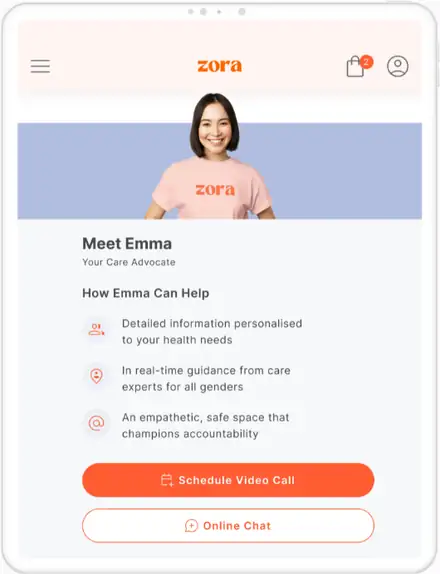
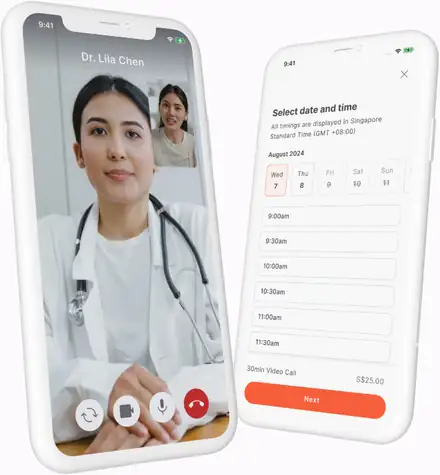
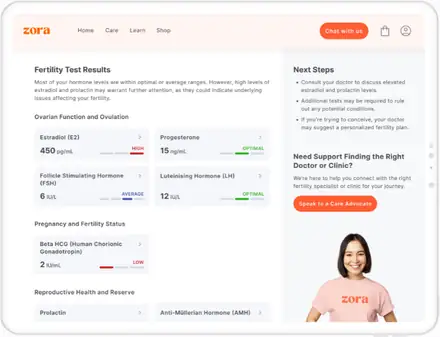
Employees join the Zora app with a company code, or single sign-on for larger teams. They can learn about fertility and egg freezing, understand what your benefit covers, book a confidential care navigation call and find partner clinics and specialists.
For HR
- Kick-off, week 1. Agree goals, countries and which employees are eligible.
- Policy and benefit design, weeks 2 to 4. Draft or update your fertility policy using our templates.
- Launch, typically weeks 4 to 6. A launch talk for employees and managers, plus a communications pack for HR to send.
- Live support. Employees book care navigation calls and use the Zora app.
- Reporting, every 3 months, on the Complete programme. Anonymised usage, common themes and our recommendations, reviewed with your account manager.
Privacy
Employee privacy is central to our programmes. On the Complete programme, routine employer reports contain aggregated engagement and utilisation information, with safeguards to prevent identification of individual employees. On every programme, personal health information is not included in standard HR reporting, and employees can get help without telling their manager. Where eligibility checks or claims administration need individual-level data, access is limited to authorised parties for defined purposes, as agreed in writing before launch. Employee data is handled in line with Singapore’s Personal Data Protection Act and Mexico’s Federal Law on the Protection of Personal Data Held by Private Parties (LFPDPPP, 2025), which treats health data as sensitive personal data that needs express written consent.
Clinics and doctors in Mexico
Zora’s clinic and doctor directory does not list providers in Mexico yet. It lists 421 clinics and 1,185 doctors across 25 countries, mostly in Asia Pacific and the Middle East (browse clinics or browse doctors). Employees in Mexico can still use Zora’s education and the Zora app. Ask us how your team in Mexico would use Zora before you launch. See Zora’s employer guides for every country.
Rules and eligibility in Mexico
Who can use assisted reproduction
Bills on assisted reproduction have been tabled since 1999 and none has passed (Gaceta Médica de México, 2017, SCJN, 2022). COFEPRIS licenses clinics; it listed 89 authorised centres in 2017. In December 2021 (Amparo en revisión 516/2018) the Supreme Court’s First Chamber held that, under the General Health Law, only the federation can set health conditions for access to assisted reproduction (Grupo Animal). In November 2017 (Amparo en revisión 619/2017) the Second Chamber ruled ISSSTE’s age limit of 35 and its legally-constituted-couple requirement discriminatory (SCJN, November 2017).
Surrogacy and donors
Tabasco’s Civil Code regulates gestation by contract, and Sinaloa’s Family Code allows total or partial surrogacy, paid or altruistic; San Luis Potosí and Querétaro prohibit it, and 19 states do not mention it (SCJN, 2022). In June 2021, in Acción de inconstitucionalidad 16/2016, the full Supreme Court struck down Tabasco rules that excluded single people and same-sex couples, required a partner’s consent and restricted custody against the child’s best interests, and held that states need not make surrogacy unpaid (SCJN, 3 June 2021). It urged the authorities to regulate surrogacy as a priority (SCJN, 7 June 2021).
Egg freezing and storage
We found no federal age limit or storage period for elective egg freezing; clinics offer it under their COFEPRIS licence. Across the Latin American registry, 13,227 fertility preservation cycles started in 2022, almost 2.7 times the number 6 years earlier (Latin American Registry, 2022 data).
Maternity and paternity leave, but no fertility leave
Under Article 170 of the Ley Federal del Trabajo, mothers have 6 weeks before birth and 6 after on full pay, and with medical approval can move up to 4 of the earlier weeks to after the birth (LFT, Article 170). Fathers have 5 paid working days (Ley Federal del Trabajo). A bill to raise paternity leave to 20 working days passed the Chamber of Deputies 409 to 1 in December 2023 (ADN40) and Senate committees in March 2024 (Infobae), but the full Senate had not voted by April 2026 (Trópico Noticias), and a payroll provider’s guide of 7 August 2026 still gave 5 days as the law in force (Pluxee, August 2026). A November 2025 bill sought 12 weeks for fathers (Expansión, January 2026). Neither is in the official list of reforms, the latest dated 14 May 2026 when checked in November 2026 (Cámara de Diputados).
Discrimination, data and recent changes
Article 56 of the Ley Federal del Trabajo bars different working conditions on grounds including pregnancy and marital status, and Article 3 also protects marital status (Ley Federal del Trabajo). The Federal Law on the Protection of Personal Data Held by Private Parties of 20 March 2025 lists present or future health status as sensitive data, requires express written consent to process it, and is overseen by the Secretaría Anticorrupción y Buen Gobierno (LFPDPPP). A reform to the Ley Federal del Trabajo to reduce the working week was published on 1 May 2026 (Cámara de Diputados).
Why employers choose Zora
Companies including Hilton, LinkedIn, Sanofi, HSBC, Mastercard, Carousell and Singapore Management University work with Zora Health. We work alongside your existing insurance, helping employees use the cover they already have and find suitable specialists based on their needs.
Trying to conceive with a heavy workload took a toll on my husband and me. It helped us understand our options.
Questions HR teams ask us
Is fertility leave mandatory in Mexico?
No. The Ley Federal del Trabajo gives mothers 12 weeks of maternity leave on full pay and fathers 5 paid working days of paternity leave, but no law gives fertility or IVF leave. A bill to raise paternity leave to 20 working days passed the Chamber of Deputies in December 2023 and Senate committees in 2024, but had not become law as of November 2026. Time off for treatment depends on employer policy.
Do IMSS or ISSSTE pay for IVF?
Only in limited cases. IMSS mainly offers lower-complexity fertility treatment, and one of its specialists said in 2024 that it does not perform IVF. ISSSTE has run an IVF programme at Centro Médico Nacional 20 de Noviembre in Mexico City, and in 2017 the Supreme Court struck down its age limit of 35 and its couples-only rule in one employee’s case. Most employees pay for IVF at private clinics.
Is elective egg freezing legal in Mexico?
Yes. We found no federal law that restricts elective egg freezing or sets an age or storage limit, and clinics offer it privately. IMSS and ISSSTE do not publish cover for it, so employees pay the clinic price plus storage.
Does Zora replace our health insurance?
No. Zora works alongside your insurance. We help employees understand their options, find suitable specialists and use the cover they already have.
How much does a fertility benefit cost an employer?
It depends on the allowance, eligibility and expected uptake. Use the budget planner on this page for a first estimate, then ask us for a tailored proposal based on your headcount and countries.
How quickly can we launch?
Typically 4 to 6 weeks from contract to launch, depending on scope and countries. Most companies start with a single talk.
Related guides for Mexican employers
Build a fertility benefit for your team
Whether you are introducing fertility benefits for the first time or improving an existing programme, tell us your headcount, countries and priorities. We will come back within two working days with suitable services, an indicative budget and a practical rollout plan for your Mexican team. No obligation.
Not ready to talk yet? Explore how Zora works
Sources
- INEGI, Encuesta Intercensal 2025, press release, September 2026
- Mexico News Daily, Mexico’s population surpasses 130 million even as fertility rate falls, September 2026
- Zegers-Hochschild et al., Assisted reproductive technologies in Latin America: the Latin American Registry, 2021
- Zegers-Hochschild et al., Assisted reproductive technologies in Latin America: the Latin American Registry, 2022, JBRA Assisted Reproduction, 2026
- Gaceta Médica de México, assisted reproduction in Mexico’s public sector, 2017
- Méndez Luna, Las Técnicas de Reproducción Asistida como Ritos de Paso, UAM Iztapalapa, 2018
- SCJN, Amparo en revisión 619/2017, summary, November 2017
- SCJN, press release 191/2017 on ISSSTE assisted reproduction programme, November 2017
- SCJN, press release 158/2021, Acción de inconstitucionalidad 16/2016, 3 June 2021
- SCJN, press release 160/2021, Acción de inconstitucionalidad 16/2016, 7 June 2021
- SCJN, La gestación por subrogación en América Latina, chapter 8 (Mexico), July 2022
- Grupo Animal, Gestación por sustitución: decisiones de la Corte
- Expansión, El sueño de ser papás se paga caro: precio de los tratamientos contra la infertilidad, 22 August 2025
- Excélsior, ¿Cuánto cuesta congelar óvulos en México?, 23 May 2025
- Informador, IMSS Jalisco ofrece tratamientos especializados para infertilidad, 7 April 2024
- Ingenes, Costos, checked November 2026
- Cámara de Diputados, Ley Federal del Trabajo (last reform DOF 14 May 2026)
- Cámara de Diputados, Ley Federal del Trabajo, list of reforms
- mley.mx, Ley Federal del Trabajo, Article 170
- ADN40, LFT: workers who could ask for 20 days of paid leave, December 2023
- Infobae, Ampliación de la licencia de paternidad a 20 días avanza en el Senado, 6 March 2024
- Trópico Noticias, Pide diputada al Senado concluir reforma para ampliar licencias de paternidad, 5 April 2026
- Expansión, 6 reformas laborales que podrían ser aprobadas en México en 2026, January 2026
- Cámara de Diputados, Ley Federal de Protección de Datos Personales en Posesión de los Particulares, DOF 20 March 2025
- Pluxee México, Incapacidad por paternidad 2026 en México, 7 August 2026
- Ferring Pharmaceuticals, Fertility Matters at Work and This Can Happen, workplace fertility survey, November 2025
- Carrot Fertility, Global Fertility at Work report, 2023
- Gallup, This fixable problem costs US businesses $1 trillion, 2019
- World Health Organization, 1 in 6 people globally affected by infertility, April 2023
Information on this page is correct as of 5 November 2026. Laws, public funding, insurance rules and treatment costs change often, so check current rules with the relevant authority, insurer or a qualified adviser before making decisions. This page is general information, not legal, financial, tax or medical advice.