
Zora Health / Employer guide / Norway
Support employees through fertility treatment, and keep the talent you have invested in.
Fertility treatment rarely fits around a work calendar, and most employees go through it quietly, often while doing some of their best work. Zora Health helps you build practical fertility support, from policies and manager guidance to confidential care navigation and access to 128+ partner clinics in 16 countries, around your workforce and budget. Companies including Hilton, LinkedIn, Sanofi, HSBC, Mastercard, Carousell and Singapore Management University work with us.
Book an employer consultation Explore the cost calculator
Five things Norwegian HR leaders should know
- Norway’s total fertility rate was 1.48 children per woman in 2025, up from 1.44 in 2024, with 55,400 children born (SSB).
- Public hospitals charge NOK 1,500 per IVF or ICSI attempt for up to 3 attempts. Many treat women only up to about 40, and waits ran from 12 to 38 weeks in May 2026.
- HELFO refunds medication above NOK 21,508 per couple or single woman in 2026, for the first 3 attempts per birth.
- Single women and elective egg freezing have been allowed since 1 July 2020, and egg donation since 1 January 2021.
- Private IVF costs NOK 48,500 to 51,400 per cycle and egg freezing NOK 32,500 to 33,500, before medication. A fixed annual allowance keeps the budget predictable.
Why fertility is a business problem for employers
Fertility treatment does not fit around a work calendar. A clinic sets the date of a scan the day before. Egg collection happens when the body is ready, usually about 36 hours after a final trigger injection. Then comes a two-week wait, and for many couples, another cycle. Your team feels it: missed meetings, unexplained absences, a strong performer who suddenly goes quiet.
The World Health Organization estimates that about 1 in 6 people worldwide are affected by infertility. A February 2024 proposal to the Storting from Venstre MPs states, without citing a study, that involuntary childlessness affects 1 in 7 couples in Norway (Stortinget, Dokument 8:87 S). In a 2023 Carrot Fertility survey of 5,000 people in Canada, India, Mexico, the UK and the US, 79% felt uncomfortable discussing fertility at work.
- Resignations. 39% of employees with fertility challenges in Ferring‘s 2025 survey of more than 3,600 people in Australia, France, Japan, Poland and the UK had left or considered leaving their job during treatment.
- No clear time off. The Working Environment Act gives pregnant employees paid time off for prenatal checks (§ 12-1, Virke). We found no statutory right to time off for fertility appointments.
- Queues. Public waits ran from 12 to 38 weeks across the 6 public sites in May 2026, while private clinics usually have little wait (Babyverden, a parenting site, May 2026). Oslo University Hospital listed 14 weeks to assessment in November 2026 (OUS).
- Unequal access. Many public clinics treat women only up to about 40 (Bioteknologirådet, 2025). Most single women are treated at private clinics (Helsedirektoratet), and private clinics record more births to women aged 40 or over (Helsedirektoratet).
What employers gain
Keep the people you spent the most to develop
Replacing an employee costs one-half to two times their annual salary, according to Gallup. 69.9% of Norwegian women aged 15 to 74 were in the labour force in the second quarter of 2026 (SSB). A written policy, paid time off and a funded allowance address the reasons people leave during treatment.
Stand out in a tight labour market
73% of employees with fertility challenges said they would be attracted to a role that offers fertility support (Ferring, 2025), and 65% said they would change jobs for fertility benefits (Carrot, 2023). We found no published example of a Norwegian employer funding IVF or egg freezing.
Make fertility support financially predictable
Aon projected an 8.0% gross rise in employer medical plan costs in Norway for 2026, as for 2025 (Aon, October 2025; full report via ConsultorSalud). A capped allowance sets a ceiling on fertility spending.
Zora helps employers structure benefits around local treatment costs, public funding rules and the law, so HR can run the programme within an agreed budget.
Want to see what this would look like for your Norwegian workforce?
What IVF costs, and what the state pays
Norway splits the bill in two. Public hospitals charge a patient fee of NOK 1,500 per IVF or ICSI attempt, including egg collection, for up to 3 attempts in the same course, and NOK 1,500 per insemination with no limit; these fees do not count towards the frikort ceiling (Helsedirektoratet, 2026). HELFO refunds medication separately for the first 3 attempts per birth, once the couple or single woman has paid NOK 21,508 in 2026 (Helsenorge, Helsedirektoratet circular).
| Item (NOK) | Medicus Oslo | Klinikk Hausken | Notes |
|---|---|---|---|
| IVF, one cycle | 48,500 | 51,400 | ICSI adds 5,800 or 5,100; Medicus 3-cycle package 97,000 up to age 39 |
| Frozen embryo transfer | 19,000 | 18,000 | Medicus charges 7,500 after a total freeze |
| Elective egg freezing, one retrieval | 33,500 | 32,500 | Hausken includes 1 year of storage; medication extra |
| Storage, per year | 3,900 eggs; 2,800 embryos | 2,800 eggs or embryos | |
| Donor egg treatment | From 130,000 | Not compared | Medicus price for 2 blastocysts |
| Medication, one stimulation cycle | About 6,500 to 14,000 | Extra | Medicus estimate, by dose; paid at the pharmacy |
Sources: Medicus Oslo price list, valid from 1 January 2026; Medicus, medication costs; Klinikk Hausken price list, from January 2026. Private clinics set their own prices.
| Item | Public support | What the employee still carries |
|---|---|---|
| IVF attempts 1 to 3, public hospital | Treatment and medication above the co-payment | NOK 1,500 per attempt, the co-payment, the wait |
| IVF attempts 1 to 3, private clinic | Medication above the co-payment | The clinic fee plus the co-payment |
| A 4th attempt, or refused on age at a public clinic | None | The full private price, including medication |
| Egg freezing without a medical reason | None | The retrieval, medication and yearly storage |
Sources: Helsenorge, HELFO reimbursement; Helsedirektoratet, circular to National Insurance Act § 5-22; Storting law decision 104 (2019 to 2020), § 2-11.
Age strongly predicts IVF success. Helsedirektoratet publishes no success rates by age, but 16% of births to women aged 40 or over in 2023 followed assisted reproduction, up from 9.4% in 2021 (Helsedirektoratet, Helsedirektoratet).
Women who had a first child after assisted reproduction were 33.6 years old on average in 2022 (Helsedirektoratet). For an employee starting in her late 30s, the size of an allowance and when she can use it matter as much as whether you offer one.
Give Employees Access to Fertility Specialists
Help employees navigate fertility care with access to doctors and clinics, treatment information, and clear guidance on IVF, egg freezing and other fertility options. Employees can explore their options privately, without needing to go through HR.
Fertility support that fits your workforce and budget
You do not need to overhaul your existing health insurance to support employees through fertility treatment. Start with awareness and manager education, add confidential one-to-one support, or introduce a funded allowance across your offices. There is no minimum company size.
Where included in the employer programme, eligible employees can use talks and care navigation without paying Zora a separate fee. Care navigation allowances are set in each proposal. Treatment and other third-party costs are paid separately, either by employees or through the fertility allowance their employer provides.
Companies starting the conversation
Essentials
Expert-led talks for employees and managers, fertility and menopause policy templates, manager guides and full access to the Zora app. Up to 2 talks a year.
Employees supported one to one
Navigation
Everything in Essentials, plus confidential one-to-one care navigation and access to our partner clinic network.
Large and multi-country teams
Complete
Everything in Navigation, plus quarterly anonymised reporting, a dedicated account manager and scheduled review meetings with HR.
Optional add-ons can be added to any programme, subject to availability: hormone and fertility diagnostics and telehealth with specialists. Pricing is tailored to your headcount, your countries and the services you choose. Most companies start with a single talk.
Request a proposal See how Zora works for employers
Comparing fertility benefit providers? Use our RFP question bank
Our RFP question bank has 40 questions, with why each one matters, what a good answer looks like and a scoring sheet for three providers. Six of the questions for Norway:
- Are local-plan employees covered, or only staff on international health plans?
- Do you require an infertility diagnosis before support starts?
- How does the allowance work alongside public treatment and HELFO, for example paying the NOK 21,508 medication co-payment, a 4th attempt or treatment after a public clinic’s age limit?
- Which clinics in Oslo, Bergen, Trondheim and Stavanger can employees use, and can the allowance pay for private treatment while an employee waits for a public hospital?
- Can the allowance pay for elective egg freezing, yearly storage and donor egg treatment, and how is it taxed as an employee benefit in Norway?
- How is health data handled under the GDPR and Norway’s Personal Data Act, and what aggregated information does the employer see?
Your download link appears here as soon as you submit. Zora Health may contact you about employee benefits; see our privacy policy.
Plan your fertility benefit budget
Fertility benefit budget planner
Model the annual claims budget for a fertility allowance. Change any number.
This is a claims budget, not a Zora quotation. Zora’s programme fees, implementation and optional services are separate.
Illustration only. Utilisation is an editable assumption, not observed Zora data. The calculation assumes each user claims their full annual allowance, and excludes programme fees and setup costs. For a tailored model, request an employer proposal.
Estimate the potential workforce impact of fertility challenges
A rough planning scenario. It applies a global infertility estimate to your headcount, so it is not a prediction for your workforce, a measured loss or a forecast of savings from any programme.
Range: NOK 2,630,833 to NOK 7,443,333 a year, depending on replacement cost.
Assumptions: infertility affects about 1 in 6 adults (World Health Organization, 2023), applied to employees aged 25 to 44. Replacing an employee costs one-half to two times their annual salary (Gallup, 2019); the headline uses the low end. Absence is valued at salary divided by 250 working days. Exit rate and days lost are your own assumptions.
This is a hypothetical cost scenario, not a prediction of actual employee departures, an estimate of Zora’s financial impact or a guaranteed saving from fertility benefits.
Already have corporate health insurance? Here is where Zora fits
Your medical plan may cover some consultations and tests, but fertility treatment is often limited or excluded, so check your policy wording. Employees still need to understand their options, the public funding they qualify for and which clinic suits them.
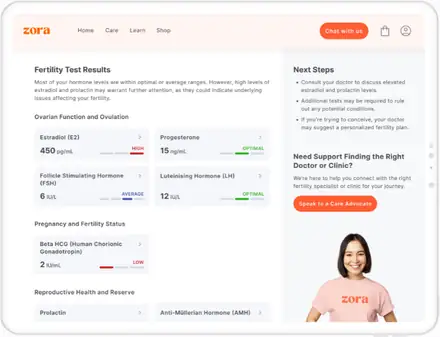
Zora works alongside your existing insurance and benefits. We help employees get reliable information, navigate their care options and reach suitable specialists, and we give HR manager guidance, policy templates and, on the Complete programme, anonymised reporting. You strengthen fertility support without replacing your medical plan.
How Zora works
For your employees
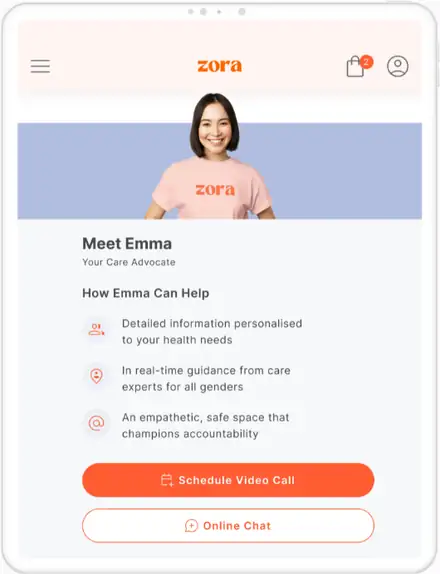
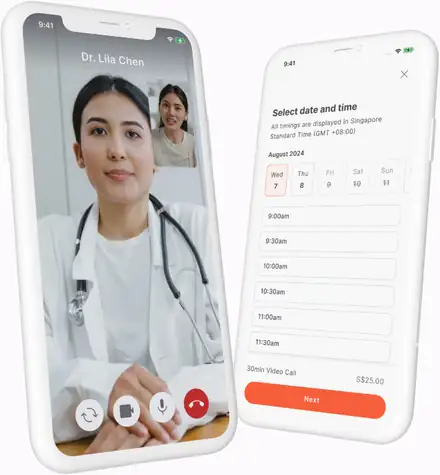
Employees join the Zora app with a company code, or single sign-on for larger teams. They can learn about fertility and egg freezing, understand what your benefit covers, book a confidential care navigation call and find partner clinics and specialists.
For HR
- Kick-off, week 1. Agree goals, countries and which employees are eligible.
- Policy and benefit design, weeks 2 to 4. Draft or update your fertility policy using our templates.
- Launch, typically weeks 4 to 6. A launch talk for employees and managers, plus a communications pack for HR to send.
- Live support. Employees book care navigation calls and use the Zora app.
- Reporting, every 3 months, on the Complete programme. Anonymised usage, common themes and our recommendations, reviewed with your account manager.
Privacy
Employee privacy is central to our programmes. On the Complete programme, routine employer reports contain aggregated engagement and utilisation information, with safeguards to prevent identification of individual employees. On every programme, personal health information is not included in standard HR reporting, and employees can get help without telling their manager. Where eligibility checks or claims administration need individual-level data, access is limited to authorised parties for defined purposes, as agreed in writing before launch. Employee data is handled in line with Singapore’s Personal Data Protection Act and Norway’s Personal Data Act (2018), which applies the GDPR in Norway as an EEA country and treats health data as special category data.
Clinics and doctors in Norway
Zora’s clinic and doctor directory does not list providers in Norway yet. It lists 421 clinics and 1,185 doctors across 25 countries, mostly in Asia Pacific and the Middle East (browse clinics or browse doctors). Employees in Norway can still use Zora’s education and the Zora app. Ask us how your team in Norway would use Zora before you launch. See Zora’s employer guides for every country.
Rules and eligibility in Norway
Who can use assisted reproduction
Married and cohabiting couples, including two women, can receive treatment, and single women can since 1 July 2020 (Stortinget, law decision 104, Helsedirektoratet). A woman cannot be older than 46 at insemination or embryo transfer. Egg donation has been allowed since 1 January 2021, with donors aged 25 to 35 (Helsedirektoratet); using donor eggs and donor sperm together, and embryo donation, are not allowed (Helsedirektoratet). A single woman must use her own eggs (Bioteknologirådet). A child conceived with a donor after 1 January 2021 can learn the donor’s identity from age 15.
Egg freezing and storage
Since 1 July 2020, approved clinics may store unfertilised eggs without a medical reason; this falls outside public health care, so clinics may charge the full price (Stortinget, Helsedirektoratet). Bioteknologirådet counted 21 people using it in 2020, 174 in 2021 and 219 in 2022 (Bioteknologirådet, 2025). Embryos are kept until the woman turns 46, though a clinic may set a shorter period of at least 5 years from fertilisation. For medical egg freezing, such as before cancer treatment, public hospitals use a guideline upper age of 35 (Helsedirektoratet).
Parental benefit and leave, but no fertility leave
For a child born from 1 July 2024, parental benefit runs for 49 weeks at 100% or 61 weeks and 1 day at 80%, capped at 6G (NOK 819,294). At 100%, the mother and the father or co-mother each have a 15-week quota, 16 weeks are shared, and the mother can start 3 weeks before the due date (NAV). The mother must take the first 6 weeks after birth, and a father has 2 weeks of care leave around the birth, unpaid unless a collective agreement or contract says otherwise (Virke).
Discrimination and health data
The Act, in force since 1 January 2018, bans discrimination on grounds including sex, pregnancy, leave for birth or adoption, care responsibilities, sexual orientation and age. Private employers with more than 50 regular employees must investigate risks of discrimination, act on them and report each year (Store norske leksikon). Under the GDPR, which Norway applies through the Personal Data Act 2018, health data is a special category whose processing is prohibited without a specific legal basis (Helsedirektoratet, Normen).
Higher co-payment and a law under review
The HELFO co-payment rose from NOK 20,761 in 2025 to NOK 21,508 in 2026 (Helsenorge). Helsedirektoratet’s evaluation of the Biotechnology Act, updated in October 2025, found that public clinics in high-demand areas set lower age limits, so patients cannot easily tell what applies (Helsedirektoratet). In February 2025 Bioteknologirådet recommended removing the Act’s medical conditions for treatment or, failing that, clarifying whether single women may have IVF without a medical indication or only after insemination (Bioteknologirådet).
Surrogacy
Surrogacy, commercial or altruistic, cannot be carried out in Norway: the Biotechnology Act bars placing eggs in another woman, and surrogacy agreements are not binding under the Children Act (Regjeringen). The birth mother is the legal mother; a genetic father can establish paternity, and the other intended parent must apply to adopt (Regjeringen). Commercial surrogacy arranged abroad was debated in the Storting in April 2026 (Stortinget, 2026).
Why employers choose Zora
Companies including Hilton, LinkedIn, Sanofi, HSBC, Mastercard, Carousell and Singapore Management University work with Zora Health. We work alongside your existing insurance, helping employees use the cover they already have and find suitable specialists based on their needs.
Trying to conceive with a heavy workload took a toll on my husband and me. It helped us understand our options.
Questions HR teams ask us
Is fertility leave mandatory in Norway?
No. There is no statutory fertility or IVF leave. Employees can use sick leave when a doctor certifies it, annual leave or leave agreed in a collective agreement or contract, and employers can add paid fertility leave in their own policy. Paid time off for prenatal checks under the Working Environment Act starts only once an employee is pregnant.
Does the public system pay for IVF in Norway?
Partly. Public hospitals charge a patient fee of NOK 1,500 per IVF or ICSI attempt for up to 3 attempts per course. HELFO refunds medication for the first 3 attempts per birth, at public or private clinics, once the couple or single woman has paid NOK 21,508 in 2026. Private clinic fees, such as NOK 48,500 to 51,400 per IVF cycle at two clinics we checked, are not refunded.
Can single women freeze their eggs or get IVF in Norway?
Since 1 July 2020, single women can receive assisted reproduction with donor sperm, and women can freeze eggs without a medical reason at approved clinics. Elective egg freezing is self-funded, at NOK 32,500 to 33,500 per retrieval at two private clinics in 2026, plus medication and storage. A single woman must use her own eggs, and she cannot be older than 46 at insemination or embryo transfer.
Does Zora replace our health insurance?
No. Zora works alongside your insurance. We help employees understand their options, find suitable specialists and use the cover they already have.
How much does a fertility benefit cost an employer?
It depends on the allowance, eligibility and expected uptake. Use the budget planner on this page for a first estimate, then ask us for a tailored proposal based on your headcount and countries.
How quickly can we launch?
Typically 4 to 6 weeks from contract to launch, depending on scope and countries. Most companies start with a single talk.
Related guides for Norwegian employers
Build a fertility benefit for your team
Whether you are introducing fertility benefits for the first time or improving an existing programme, tell us your headcount, countries and priorities. We will come back within two working days with suitable services, an indicative budget and a practical rollout plan for your Norwegian team. No obligation.
Not ready to talk yet? Explore how Zora works
Sources
- SSB, Fruktbarheten fortsetter å øke, 12 March 2026
- SSB, Arbeidskraftundersøkelsen, 2nd quarter 2026
- Helsedirektoratet, Egenandeler og pasientbetaling ved poliklinisk helsehjelp, 2026
- Helsedirektoratet, Rundskriv til folketrygdloven § 5-22: legemidler ved infertilitetsbehandling
- Helsenorge, Reimbursement of expenses for infertility treatment and PGD treatment
- Babyverden, Assistert befruktning: offentlig eller privat?, updated May 2026
- Medicus, Prisliste Oslo, valid from 1 January 2026
- Medicus, Priser and medication costs
- Helsedirektoratet, Assistert befruktning i Norge 2007 til 2023: barn fødde etter assistert befruktning
- Helsedirektoratet, Assistert befruktning i Norge 2007 til 2023: data om behandlingar utført i 2023
- Helsedirektoratet, Assistert befruktning i Norge 2007 til 2023: fødslar fordelt på aldersgrupper
- Helsedirektoratet, Assistert befruktning i Norge 2007 til 2023: fordeling av offentlege og private klinikkar
- Helsedirektoratet, Evaluering av bioteknologiloven 2024 to 2025, delrapport 2: utvikling basert på statistikk
- Helsedirektoratet, Evaluering av bioteknologiloven 2024 to 2025, delrapport 2: prioritering i den offentlige spesialisthelsetjenesten, October 2025
- Helsedirektoratet, Faktaboks 3-2: endringene i bioteknologiloven 2020
- Helsedirektoratet, Tilbud om assistert befruktning i Norge
- Bioteknologirådet, Fråsegn om vilkår for assistert befruktning, 28 February 2025
- Stortinget, Lovvedtak 104 (2019 to 2020), endringer i bioteknologiloven
- Stortinget, Representantforslag 87 S (2023 to 2024), 8 February 2024
- Oslo universitetssykehus, Assistert befruktning
- NAV, Foreldrepenger
- Virke, Graviditet, fødsel og adopsjon
- Store norske leksikon, Likestillings- og diskrimineringsloven
- Helsedirektoratet, Normen: behandlingsgrunnlag for helse- og personopplysninger
- Aon, The Global Medical Trend Rates Report
- Aon, Global Medical Trend Rates Report 2026 (October 2025), full PDF as hosted by ConsultorSalud
- Klinikk Hausken, Prisliste, prices from January 2026
- Helsedirektoratet, Egg- og sæddonasjon
- Helsedirektoratet, Evaluering av bioteknologiloven, delrapport 1: utvikling i Norge etter lovendringer i 2020
- Regjeringen (Ministry of Children and Families), Surrogati
- Stortinget, interpellation debate on surrogacy, 23 April 2026
- Ferring Pharmaceuticals, Fertility Matters at Work and This Can Happen, workplace fertility survey, November 2025
- Carrot Fertility, Global Fertility at Work report, 2023
- Gallup, This fixable problem costs US businesses $1 trillion, 2019
- World Health Organization, 1 in 6 people globally affected by infertility, April 2023
Information on this page is correct as of 5 November 2026. Laws, public funding, insurance rules and treatment costs change often, so check current rules with the relevant authority, insurer or a qualified adviser before making decisions. This page is general information, not legal, financial, tax or medical advice.