
Zora Health / Employer guide / Poland
Support employees through fertility treatment, and keep the talent you have invested in.
Fertility treatment rarely fits around a work calendar, and most employees go through it quietly, often while doing some of their best work. Zora Health helps you build practical fertility support, from policies and manager guidance to confidential care navigation and access to 128+ partner clinics in 16 countries, around your workforce and budget. Companies including Hilton, LinkedIn, Sanofi, HSBC, Mastercard, Carousell and Singapore Management University work with us.
Book an employer consultation Explore the cost calculator
Five things Polish HR leaders should know
- Poland’s total fertility rate was 1.07 in 2025 (GUS), with about 238,000 births.
- The national IVF programme (June 2024 to 2028) funds up to 4 cycles with a couple’s own eggs, 2 with donor eggs or 6 with donor embryos, for married or cohabiting couples; 56,236 couples had qualified by 30 September 2026.
- The 2015 Infertility Treatment Act excludes single and same-sex patients, bans destroying viable embryos and allows egg freezing for medical reasons; Nasz Bocian reads it as ruling out social freezing.
- There is no fertility leave. Maternity leave is 20 weeks, plus up to 15 weeks since 19 March 2025 for premature or hospitalised newborns.
- A fixed annual allowance can cover what the programme leaves out: drugs, tests, extra cycles and treatment abroad.
Why fertility is a business problem for employers
Fertility treatment runs on the clinic’s calendar. A scan is booked the day before, egg collection follows a trigger injection by about 36 hours, and then comes a two-week wait and often another cycle. Your team sees missed meetings, unexplained absences and a strong performer who goes quiet.
About 1 in 6 people worldwide are affected by infertility (World Health Organization), and the Polish government puts the number of couples facing infertility at up to 1.5 million (Chancellery of the Prime Minister, June 2026). In a November 2024 survey of 518 people with infertility by the patient association Nasz Bocian, 50.6% had not told their employer about treatment, and 85.4% said their workplace had no policy for staff in treatment.
- Resignations. 39% of employees with fertility challenges had left or considered leaving their job during treatment, in Ferring‘s 2025 survey of 3,030 employees and 639 employers in Australia, France, Japan, Poland and the UK. Among the 170 Polish employees, 76% said treatment had affected their career, the highest of the 5 countries.
- Stalled careers. In the Nasz Bocian survey, 96.9% had taken days off, 51.7% had given up changing jobs and 20.2% had turned down a promotion.
- Funding runs out. 73% of 37 programme centres surveyed in early 2026 named their annual funding limit as the main barrier, and some closed qualification by mid-year or paused treatment for months (Nasz Bocian, 2026).
What employers gain
Keep the people you spent the most to develop
Replacing an employee costs one-half to two times their annual salary, according to Gallup. Polish women were 29.5 on average at their first birth in 2025, and 52.2% of women aged 15 to 89 were economically active (GUS), so treatment often falls in the years when careers build. A written policy, paid time off and a funded allowance can help address barriers that contribute to attrition.
Stand out in a tight labour market
73% of employees with fertility challenges would be attracted to an employer offering fertility support, and 93% in Poland (Ferring, 2025). In the Nasz Bocian survey, 93.2% had received no financial support from their employer. DP World has funded Nasz Bocian’s Fertility at Work project, which runs free fertility training for employers.
Make fertility support financially predictable
Employers can set annual or lifetime allowances and choose which treatments qualify. WTW’s 2026 Global Medical Trends Survey projects a gross medical cost trend of 14.3% for Poland in 2026 (WTW), so a fixed allowance is easier to budget than open-ended cover.
Zora helps employers structure benefits around local treatment costs, the national IVF programme and workforce needs, so HR can run the programme within an agreed budget.
Want to see what this would look like for your Polish workforce?
What IVF costs, and what the state pays
Since 1 June 2024, the Ministry of Health has funded IVF through a national programme planned to run to 31 December 2028, with at least PLN 500 million a year in the law (Ministry of Health). On 1 June 2026 the government said it was raising annual funding to PLN 600 million (Chancellery of the Prime Minister). 58 centres take part.
| Item | Private price (PLN) | Notes |
|---|---|---|
| First fertility consultation | 380 | Follow-up 320 |
| IVF with ICSI, clinic package | 11,200 | Retrieval 2,000, anaesthesia 900, embryology 4,600, ICSI 1,600, fresh transfer 2,100 |
| IVF procedure, mid-tier clinics | about 5,600 to 6,600 | Plus about 900 to 1,500 for preparation, drugs and tests (kb.pl) |
| Stimulation drugs | varies | 15.8% of programme patients surveyed spent more than 5,000 on drugs (Nasz Bocian) |
| Frozen embryo transfer | 2,600 | Per transfer |
| Egg freezing (vitrification) | 1,000 | Listed with IVF options, plus retrieval, anaesthesia and drugs |
| Egg storage | about 800 to 950 in year 1 | About 330 to 450 each later year (kb.pl) |
| Egg donation | 14,950 plus 14,900 | Donor preparation, then IVF with transfer |
Sources: Invimed price list, Warsaw Mokotów, October 2026; kb.pl, January 2026; Nasz Bocian, 2026, survey of 767 patients. Prices are Invimed’s unless marked, and vary by clinic and city.
| Item | Public support (or own savings) | What the employee still carries |
|---|---|---|
| National IVF programme | Qualification, tests and procedures: up to 4 cycles with own eggs or donor sperm, 2 with donor eggs or 6 with donor embryos; embryo storage during the programme | Drugs (reimbursed under rules in force since 1 July 2024), genetic testing, extras; 46.2% of patients surveyed paid for qualification tests |
| Fertility preservation before cancer treatment | Funded freezing of eggs, sperm or tissue, women from puberty to 40 and men to 45 | Drugs and time off |
| Local government programmes (2024) | In April 2024, about 70 local programmes paid around PLN 5,000 to 10,000 per procedure. Many have since closed, including Wrocław on 31 May 2024 and Warsaw on 1 December 2024, as councils cannot fund care the state budget covers | The full private price outside the national programme |
| Women over 42, single and same-sex employees | Own savings (no public support) | The full private price, or treatment abroad |
| Tax | We found no Polish tax relief for IVF costs. Benefits from the Company Social Benefits Fund are exempt from income tax up to PLN 1,000 a year in total, a limit the Ministry of Finance declined to raise in July 2026 (not a subsidy) | Everything above that amount |
Sources: pacjent.gov.pl; Ministry of Health; Nasz Bocian, 2026; OKO.press, April 2024; Warsaw 19115, November 2025; City of Wrocław, July 2026; Infor.pl, July 2026.
Age strongly predicts IVF success. We found no Polish breakdown by age; in Germany’s national registry, the birth rate per fresh embryo transfer in 2023 was 30.9% for women aged 30 to 34, 26.3% at 35 and 9.3% at 41 to 44 (Deutsches IVF-Register, Jahrbuch 2024).
Across all ages, Poland’s programme had reported 34,622 clinical pregnancies and 18,040 births by 30 September 2026 (Ministry of Health). With age limits and mid-year funding gaps, the size and timing of an allowance matter as much as offering one.
Give Employees Access to Fertility Specialists
Help employees navigate fertility care with access to doctors and clinics, treatment information, and clear guidance on IVF, egg freezing and other fertility options. Employees can explore their options privately, without needing to go through HR.
Fertility support that fits your workforce and budget
You do not need to overhaul your existing health insurance to support employees through fertility treatment. Start with awareness and manager education, add confidential one-to-one support, or introduce a funded allowance across your offices. There is no minimum company size.
Where included in the employer programme, eligible employees can use talks and care navigation without paying Zora a separate fee. Care navigation allowances are set in each proposal. Treatment and other third-party costs are paid separately, either by employees or through the fertility allowance their employer provides.
Companies starting the conversation
Essentials
Expert-led talks for employees and managers, fertility and menopause policy templates, manager guides and full access to the Zora app. Up to 2 talks a year.
Employees supported one to one
Navigation
Everything in Essentials, plus confidential one-to-one care navigation and access to our partner clinic network.
Large and multi-country teams
Complete
Everything in Navigation, plus quarterly anonymised reporting, a dedicated account manager and scheduled review meetings with HR.
Optional add-ons can be added to any programme, subject to availability: hormone and fertility diagnostics and telehealth with specialists. Pricing is tailored to your headcount, your countries and the services you choose. Most companies start with a single talk.
Request a proposal See how Zora works for employers
Comparing fertility benefit providers? Use our RFP question bank
Our RFP question bank has 40 questions, with why each one matters, what a good answer looks like and a scoring sheet for three providers. Six of the questions for Poland:
- Are local-plan employees covered, or only staff on international health plans?
- Do you require an infertility diagnosis before support starts?
- How does the allowance sit alongside the national IVF programme, so employees use public funding first and claim drugs, tests and extras from the allowance?
- Can employees outside the programme, such as women over 42 or those seeking egg freezing abroad, use the benefit, and how do you apply the 2015 Infertility Treatment Act to each request?
- Which clinics in Warsaw, Kraków, Wrocław, Poznań, Gdańsk and other cities do you work with, and how do you help when a programme centre has used its annual funding?
- How do you handle health data as special category data under the GDPR and Article 22¹b of the Labour Code, and what will the employer see?
Your download link appears here as soon as you submit. Zora Health may contact you about employee benefits; see our privacy policy.
Plan your fertility benefit budget
Fertility benefit budget planner
Model the annual claims budget for a fertility allowance. Change any number.
This is a claims budget, not a Zora quotation. Zora’s programme fees, implementation and optional services are separate.
Illustration only. Utilisation is an editable assumption, not observed Zora data. The calculation assumes each user claims their full annual allowance, and excludes programme fees and setup costs. For a tailored model, request an employer proposal.
Estimate the potential workforce impact of fertility challenges
A rough planning scenario. It applies a global infertility estimate to your headcount, so it is not a prediction for your workforce, a measured loss or a forecast of savings from any programme.
Range: PLN 451,000 to PLN 1,276,000 a year, depending on replacement cost.
Assumptions: infertility affects about 1 in 6 adults (World Health Organization, 2023), applied to employees aged 25 to 44. Replacing an employee costs one-half to two times their annual salary (Gallup, 2019); the headline uses the low end. Absence is valued at salary divided by 250 working days. Exit rate and days lost are your own assumptions.
This is a hypothetical cost scenario, not a prediction of actual employee departures, an estimate of Zora’s financial impact or a guaranteed saving from fertility benefits.
Already have corporate health insurance? Here is where Zora fits
Your medical plan may cover some consultations and tests, but fertility treatment is often limited or excluded, so check your policy wording. Employees still need to understand their options, the public funding they qualify for and which clinic suits them.
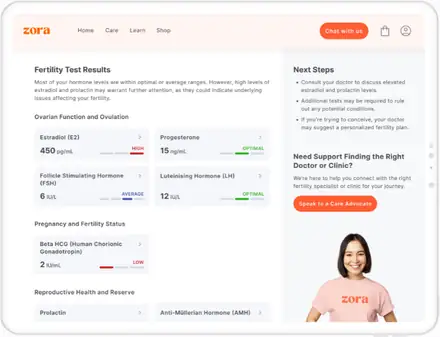
Zora works alongside your existing insurance and benefits. We help employees get reliable information, navigate their care options and reach suitable specialists, and we give HR manager guidance, policy templates and, on the Complete programme, anonymised reporting. You strengthen fertility support without replacing your medical plan.
How Zora works
For your employees
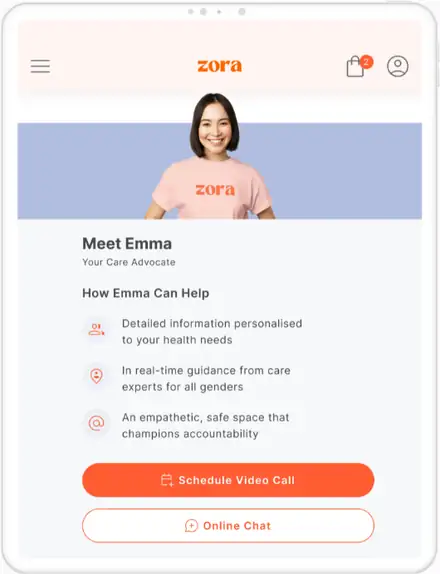
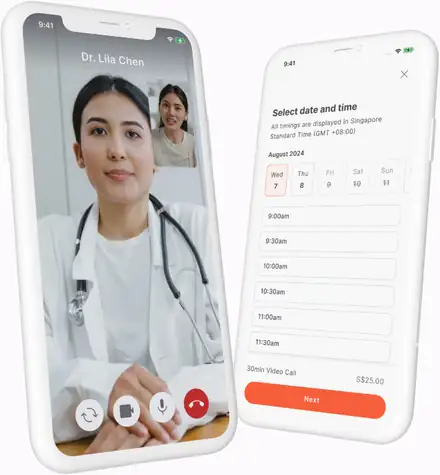
Employees join the Zora app with a company code, or single sign-on for larger teams. They can learn about fertility and egg freezing, understand what your benefit covers, book a confidential care navigation call and find partner clinics and specialists.
For HR
- Kick-off, week 1. Agree goals, countries and which employees are eligible.
- Policy and benefit design, weeks 2 to 4. Draft or update your fertility policy using our templates.
- Launch, typically weeks 4 to 6. A launch talk for employees and managers, plus a communications pack for HR to send.
- Live support. Employees book care navigation calls and use the Zora app.
- Reporting, every 3 months, on the Complete programme. Anonymised usage, common themes and our recommendations, reviewed with your account manager.
Privacy
Employee privacy is central to our programmes. On the Complete programme, routine employer reports contain aggregated engagement and utilisation information, with safeguards to prevent identification of individual employees. On every programme, personal health information is not included in standard HR reporting, and employees can get help without telling their manager. Where eligibility checks or claims administration need individual-level data, access is limited to authorised parties for defined purposes, as agreed in writing before launch. Employee data is handled in line with Singapore’s Personal Data Protection Act and Poland’s application of the EU General Data Protection Regulation (GDPR) and the Personal Data Protection Act of 10 May 2018, which treat health data as special category data.
Clinics and doctors in Poland
Zora’s clinic and doctor directory does not list providers in Poland yet. It lists 421 clinics and 1,185 doctors across 25 countries, mostly in Asia Pacific and the Middle East (browse clinics or browse doctors). Employees in Poland can still use Zora’s education and the Zora app. Ask us how your team in Poland would use Zora before you launch. See Zora’s employer guides for every country.
Rules and eligibility in Poland
Who can use assisted reproduction
The Infertility Treatment Act took effect on 1 November 2015 and limits treatment to married couples or a woman and man living together (Helsinki Foundation for Human Rights), so single and same-sex employees cannot be treated in Poland. No more than 6 eggs may be fertilised unless the woman is 35 or over, there are medical reasons or 2 earlier cycles failed; donation is anonymous, and a donor’s gametes may not be used once 10 children have been born from them (Act text). Viable embryos may not be destroyed and pass to anonymous donation after up to 20 years of storage (PET BioNews, 2025).
Embryos stored by single women
Single women who stored embryos made with donor sperm before the Act cannot use them. The Constitutional Tribunal flagged this as unequal treatment in 2018 (case S 2/18). On 9 July 2026 the Commissioner for Human Rights asked the health minister to start legislative work on it. On 17 August the ministry replied that the rules may be reviewed when the Act is amended, with no timetable (Commissioner for Human Rights, August 2026).
Allowed for medical reasons
The Act allows eggs to be stored as fertility preservation when illness or treatment puts fertility at risk, and their later use follows the same rules on who can be treated (Act text, Articles 10 and 31). Nasz Bocian reads the Act as ruling out egg freezing for social, non-medical reasons (Nasz Bocian, Social Freezing report, 2025).
Maternity, parental and paternity leave
Maternity leave is 20 weeks at 100% pay. Parental leave is 41 weeks, 9 of them reserved for the second parent, usually at 70%. Fathers get 2 weeks of paternity leave at 100%, taken before the child turns 1 (ZUS, June 2026). Since 19 March 2025, supplementary maternity leave adds up to 8 weeks, or 15 for babies born before 28 weeks or weighing 1,000 g or less (ZUS, May 2026). From 1 May 2026, private employers must count contract and self-employed work toward seniority, which can raise annual leave (HRappka, 2026).
Discrimination, flexible work and health data
Article 18³a bans discrimination on grounds including sex and sexual orientation (Labour Code, Article 18³a). Dismissal in pregnancy and maternity leave is banned with narrow exceptions, and fixed-term contracts ending after the third month of pregnancy run until birth (Article 177). Parents of children under 8 can request flexible work, and a parent of a child up to 4 must be granted remote work unless the job makes it impossible (Zielona Linia). An employer may process health data on consent only when the employee volunteers it (Article 22¹b, Prawo.pl).
Surrogacy
Polish law neither expressly permits nor bans surrogacy, commercial or altruistic, and surrogacy contracts are treated as void (HFHR, 2019). Under Article 61(9) of the Family and Guardianship Code the woman who gives birth is the mother, whatever the genetic link, and this cannot be challenged. There is no direct route for intended parents; adoption under Article 119(1a) by the partner of a biological parent has been suggested as one route (Polish Journal of Political Science, 2025).
Why employers choose Zora
Companies including Hilton, LinkedIn, Sanofi, HSBC, Mastercard, Carousell and Singapore Management University work with Zora Health. We work alongside your existing insurance, helping employees use the cover they already have and find suitable specialists based on their needs.
Trying to conceive with a heavy workload took a toll on my husband and me. It helped us understand our options.
Questions HR teams ask us
Is fertility leave mandatory in Poland?
No. Polish law has no fertility leave, so time off for appointments depends on the employer’s policy or the employee’s own leave. Once an employee is pregnant, the Labour Code protects her from dismissal, and maternity leave is 20 weeks at full pay.
Does the state pay for IVF in Poland?
Yes, for couples who qualify. Since 1 June 2024, the national programme has funded up to 6 assisted reproduction procedures (up to 4 with own eggs) for married or cohabiting couples, with women up to 42 using their own eggs (45 with donor eggs or embryos) and men up to 55. Drugs are outside the programme but can be reimbursed, and some centres have run out of annual funding before the year ends.
Can employees freeze their eggs in Poland?
For medical reasons, yes. The 2015 Act allows egg freezing as fertility preservation when illness or treatment puts fertility at risk, and the national programme funds it for people facing cancer treatment. Patient group Nasz Bocian reads the Act as ruling out freezing for social reasons, so employees seeking elective freezing often look abroad. One Warsaw clinic lists vitrification at PLN 1,000, on top of retrieval, anaesthesia and drugs.
Does Zora replace our health insurance?
No. Zora works alongside your insurance. We help employees understand their options, find suitable specialists and use the cover they already have.
How much does a fertility benefit cost an employer?
It depends on the allowance, eligibility and expected uptake. Use the budget planner on this page for a first estimate, then ask us for a tailored proposal based on your headcount and countries.
How quickly can we launch?
Typically 4 to 6 weeks from contract to launch, depending on scope and countries. Most companies start with a single talk.
Related guides for Polish employers
Build a fertility benefit for your team
Whether you are introducing fertility benefits for the first time or improving an existing programme, tell us your headcount, countries and priorities. We will come back within two working days with suitable services, an indicative budget and a practical rollout plan for your Polish team. No obligation.
Not ready to talk yet? Explore how Zora works
Sources
- GUS, Polska w liczbach 2026
- Inwestycje.pl, Liczba ludności Polski obniżyła się o 157 tys. r/r do 37,33 mln w 2025, January 2026
- Ministry of Health, In vitro (programme statistics to 30 September 2026)
- pacjent.gov.pl, Program leczenia niepłodności (in vitro)
- Chancellery of the Prime Minister, 15 tysięcy dzieci urodzonych dzięki rządowemu programowi in vitro, June 2026
- Nasz Bocian, Program refundacji in vitro: perspektywa pacjentów i realizatorów, 2026
- Nasz Bocian, Fertility at Work, survey of November 2024
- OKO.press, Państwo daje na in vitro 500 mln zł, a dzięki samorządom wciąż rodzą się dzieci, April 2024
- Warsaw 19115, In vitro: program polityki zdrowotnej, November 2025
- City of Wrocław, Koniec programu in vitro we Wrocławiu, July 2026
- Ustawa z dnia 25 czerwca 2015 r. o leczeniu niepłodności (Dz.U. 2015 poz. 1087)
- PET BioNews, Frozen embryos in Poland: the need for legal change, February 2025
- Helsinki Foundation for Human Rights, Infertility Treatment Act needs corrections
- Nasz Bocian, Raport Social Freezing (legal position for 2024), January 2025
- Commissioner for Human Rights, Zarodki z komórek rozrodczych samotnych kobiet: odpowiedź MZ, August 2026
- Infor.pl, Limit ZFŚS a podatek w 2026, July 2026
- Ferring Pharmaceuticals, The Impact of Fertility Challenges at Work: International Insights, November 2025
- Invimed, Cennik, October 2026
- kb.pl, Jaka jest cena in vitro, January 2026
- ZUS press release, Nie tylko mama. Tata też ma prawo do płatnego urlopu po narodzinach dziecka, June 2026
- ZUS press release, ZUS wspiera mamy na każdym etapie macierzyństwa, May 2026
- Forvis Mazars, Dodatkowy urlop macierzyński, March 2025
- HRappka, Nowości kadrowo-płacowe 2026, January 2026
- Labour Code, Article 177 (arslege.pl)
- Labour Code, Article 18³a (Standardy Prawa)
- Zielona Linia, Elastyczne formy zatrudnienia dla rodziców dzieci do lat 8, July 2023
- Prawo.pl, Prawo pracodawcy do żądania informacji o stanie zdrowia pracownika, November 2022
- General Data Protection Regulation, Article 9
- WTW, Europe’s medical inflation sees modest growth in 2026, February 2026
- Deutsches IVF-Register, Jahrbuch 2024, edition for couples
- Helsinki Foundation for Human Rights, Transcription of birth certificates of surrogate-born children, 2019
- Polish Journal of Political Science, The Legal Vacuum of Surrogacy and Its Implications for Childhood Statelessness, 2025
- Ferring Pharmaceuticals, Fertility Matters at Work and This Can Happen, workplace fertility survey, November 2025
- Carrot Fertility, Global Fertility at Work report, 2023
- Gallup, This fixable problem costs US businesses $1 trillion, 2019
- World Health Organization, 1 in 6 people globally affected by infertility, April 2023
Information on this page is correct as of 5 November 2026. Laws, public funding, insurance rules and treatment costs change often, so check current rules with the relevant authority, insurer or a qualified adviser before making decisions. This page is general information, not legal, financial, tax or medical advice.