
Zora Health / Employer guide / Serbia
Support employees through fertility treatment, and keep the talent you have invested in.
Fertility treatment rarely fits around a work calendar, and most employees go through it quietly, often while doing some of their best work. Zora Health helps you build practical fertility support, from policies and manager guidance to confidential care navigation and access to 128+ partner clinics in 16 countries, around your workforce and budget. Companies including Hilton, LinkedIn, Sanofi, HSBC, Mastercard, Carousell and Singapore Management University work with us.
Book an employer consultation Explore the cost calculator
Five things Serbian HR leaders should know
- Serbia’s total fertility rate was 1.62 in 2025, slightly below 1.63 in 2024, and 59,483 children were born, down from 60,845 a year earlier (Statistical Office, final data).
- The state health insurance fund, RFZO, pays for IVF for women under 45: unlimited attempts for a first child, and 2 stimulated cycles and 3 frozen transfers for a second.
- The 2017 Law on Biomedically Assisted Fertilisation allows treatment for married and unmarried couples and, as an exception, for a single woman; surrogacy is a criminal offence.
- Serbia has no fertility or IVF leave. Fathers rely on up to 5 days of paid leave a year for family events, which include a wife’s childbirth.
- One private clinic in Serbia lists an ICSI cycle at RSD 280,000 (June 2026 price list), so a fixed allowance can cover what RFZO leaves out, such as elective egg freezing or treatment after 45, and keeps the budget predictable.
Why fertility is a business problem for employers
Fertility treatment does not fit around a work calendar. A clinic sets the date of a scan the day before. Egg collection happens when the body is ready, usually about 36 hours after a final trigger injection. Then comes a two-week wait, and for many couples, another cycle. Your team feels it: missed meetings, unexplained absences, a strong performer who suddenly goes quiet.
The World Health Organization estimates that about 1 in 6 people worldwide are affected by infertility. Serbia has no reliable national figure, and a 2022 review found that the planned State Infertility Registry had not been set up (Rašević and Sedlecky, Stanovništvo, 2022). RFZO had received 7,200 IVF requests in 2022 by November (Danas, November 2022). We found no Serbian survey on fertility treatment at work, so the workplace figures below come from other countries. In Carrot’s 2023 survey of 5,000 people in Canada, India, Mexico, the UK and the US, 79% felt uncomfortable discussing fertility at work (Carrot).
- Resignations. 39% of respondents with fertility challenges in Ferring‘s 2025 survey of more than 3,600 people in Australia, France, Japan, Poland and the UK had left or considered leaving their job during treatment.
- Lower performance. 55% of respondents in the same Carrot survey said fertility challenges had hurt their work performance.
- Appointments with no leave. RFZO cases need tests, referrals and a commission decision, and tests in state institutions can take up to 2 months (Danas, November 2022). The Labour Law gives no leave for this.
- Cover that stops at 45. RFZO funds treatment only where the woman is under 45 when the commission assesses her, and does not fund elective egg freezing (025.rs, citing Tanjug, October 2026; BB Clinic, 2026).
What employers gain
Keep the people you spent the most to develop
Replacing an employee costs one-half to two times their annual salary, according to Gallup. Women in Serbia had their first child at 29.1 on average in 2025 (Statistical Office of Serbia), and 60.7% of women aged 15 to 64 were employed at the end of 2025, against 71.3% of men (Labour Force Survey). A written policy, paid time off and a funded allowance can help address barriers that contribute to employee attrition.
Stand out in a tight labour market
65% of respondents in the Carrot survey said they would change jobs for an employer with fertility benefits (Carrot). In 2022, UniCredit’s bank in Serbia offered a number of its female employees reimbursement of up to €5,000 for one IVF attempt, in Serbia or abroad (UniCredit, Annual Report 2022).
Make fertility support financially predictable
Aon projected that medical costs in Serbia would rise by 15% in 2026, after 20% in 2025, against a European average of 8.2% for 2026; these are gross figures, before inflation (11.7% net for Serbia in 2026) (Aon, Global Medical Trend Rates Report 2026). A fixed allowance is easier to budget than open-ended cover.
Zora helps employers structure benefits around local treatment costs, what RFZO already pays and the age and attempt limits, so HR can run the programme within an agreed budget.
Want to see what this would look like for your Serbian workforce?
What IVF costs, and what the state pays
RFZO spent RSD 8 billion on IVF in the 10 years to 2023 (021.rs, citing Tanjug, November 2023). In 2022 it put the cost of an IVF cycle with embryo freezing at about RSD 264,000 (Biznis.rs, May 2022). Funded treatment takes place in state hospitals and in private clinics under contract: 16 private clinics in 2024 (021.rs, February 2024), and RFZO said in April 2026 that it continues to add clinics (Ozon, April 2026).
| Item | Private price (RSD) | Notes |
|---|---|---|
| IVF, stimulated cycle | 240,000 | Intermedicus BIS list price |
| ICSI, stimulated cycle | 280,000 | Same clinic |
| Egg freezing, storage up to 5 years | 70,000 | Plus egg retrieval, 142,500, and drugs |
| Embryo vitrification, 1 embryo | 40,000 | Storage up to 2 years; extension 15,000 a year |
| Intrauterine insemination (IUI) | 55,000 | With follicle monitoring |
| IVF with imported donor cells | about €7,000 | Whole procedure with donor cells and transport, reported in 2022; RFZO pays for those who qualify |
Sources: Intermedicus BIS price list, updated June 2026; N1, November 2022. The clinic list does not say that drugs are included, and prices vary by clinic and city. We found no tax relief for IVF costs in Serbia.
| Item | Public support (or own savings) | What the employee still carries |
|---|---|---|
| First child (couple with no joint child) | RFZO: unlimited stimulated cycles and frozen transfers, woman under 45 | Travel, time off and any extras the clinic charges |
| Second child | RFZO: 2 stimulated cycles and 3 frozen transfers, woman under 45 | Further cycles at the private price |
| Donor eggs or sperm (couples) | RFZO: up to 3 donor cycles, 3 frozen transfers and 1 import of donor cells | Further cycles at the private price |
| Single woman with no child | RFZO: 3 stimulated cycles with donor sperm and 3 frozen transfers, under 45 | Further cycles at the private price |
| Elective egg freezing | No RFZO funding; own savings | The full private price |
| Woman aged 45 or over | No RFZO funding; own savings | The full private price |
Sources: RFZO rulebook for 2022, Article 5 (Official Gazette 24/2022), with the age limit raised to 45 in July 2022; 025.rs, citing Tanjug, October 2026; BB Clinic RFZO guide, 2026; 021.rs, February 2024. RFZO also asks for a BMI of 30 or less (BB Clinic), and commission approval is valid for a year. In February 2024 RFZO told 021.rs that no IVF waiting-list records exist.
Age is one of the strongest predictors of IVF success, alongside individual medical and treatment factors. Serbia publishes no national IVF results by age; in Germany’s national registry, the birth rate per fresh embryo transfer in 2023 was 30.9% for women aged 30 to 34, 26.3% at 35 and 9.3% at 41 to 44 (Deutsches IVF-Register, Jahrbuch 2024).
RFZO funding ends for women who reach 45 before the commission assesses them, and elective egg freezing is paid privately, which is why the size of an allowance, and when employees can use it, matter as much as whether you offer one.
Give Employees Access to Fertility Specialists
Help employees navigate fertility care with access to doctors and clinics, treatment information, and clear guidance on IVF, egg freezing and other fertility options. Employees can explore their options privately, without needing to go through HR.
Fertility support that fits your workforce and budget
You do not need to overhaul your existing health insurance to support employees through fertility treatment. Start with awareness and manager education, add confidential one-to-one support, or introduce a funded allowance across your offices. There is no minimum company size.
Where included in the employer programme, eligible employees can use talks and care navigation without paying Zora a separate fee. Care navigation allowances are set in each proposal. Treatment and other third-party costs are paid separately, either by employees or through the fertility allowance their employer provides.
Companies starting the conversation
Essentials
Expert-led talks for employees and managers, fertility and menopause policy templates, manager guides and full access to the Zora app. Up to 2 talks a year.
Employees supported one to one
Navigation
Everything in Essentials, plus confidential one-to-one care navigation and access to our partner clinic network.
Large and multi-country teams
Complete
Everything in Navigation, plus quarterly anonymised reporting, a dedicated account manager and scheduled review meetings with HR.
Optional add-ons can be added to any programme, subject to availability: hormone and fertility diagnostics and telehealth with specialists. Pricing is tailored to your headcount, your countries and the services you choose. Most companies start with a single talk.
Request a proposal See how Zora works for employers
Comparing fertility benefit providers? Use our RFP question bank
Our RFP question bank has 40 questions, with why each one matters, what a good answer looks like and a scoring sheet for three providers. Six of the questions for Serbia:
- Are local-plan employees covered, or only staff on international health plans?
- Do you require an infertility diagnosis before support starts?
- How does the allowance sit alongside RFZO funding, so employees use their insured cycles first and claim drugs, extra cycles, genetic testing and storage from the allowance?
- Can employees RFZO does not fund, such as women aged 45 or over, those choosing elective egg freezing or staff outside the state insurance system, use the benefit, and how do you handle requests Serbian law does not allow, such as surrogacy?
- Which state and private clinics in Belgrade, Novi Sad, Niš and Kragujevac do you work with, and which have an RFZO contract?
- How do you handle health data as a special category under Serbia’s Law on Personal Data Protection, and what will the employer see when an employee requests time off or an allowance?
Your download link appears here as soon as you submit. Zora Health may contact you about employee benefits; see our privacy policy.
Plan your fertility benefit budget
Fertility benefit budget planner
Model the annual claims budget for a fertility allowance. Change any number.
This is a claims budget, not a Zora quotation. Zora’s programme fees, implementation and optional services are separate.
Illustration only. Utilisation is an editable assumption, not observed Zora data. The calculation assumes each user claims their full annual allowance, and excludes programme fees and setup costs. For a tailored model, request an employer proposal.
Estimate the potential workforce impact of fertility challenges
A rough planning scenario. It applies a global infertility estimate to your headcount, so it is not a prediction for your workforce, a measured loss or a forecast of savings from any programme.
Range: RSD 9,020,000 to RSD 25,520,000 a year, depending on replacement cost.
Assumptions: infertility affects about 1 in 6 adults (World Health Organization, 2023), applied to employees aged 25 to 44. Replacing an employee costs one-half to two times their annual salary (Gallup, 2019); the headline uses the low end. Absence is valued at salary divided by 250 working days. Exit rate and days lost are your own assumptions.
This is a hypothetical cost scenario, not a prediction of actual employee departures, an estimate of Zora’s financial impact or a guaranteed saving from fertility benefits.
Already have corporate health insurance? Here is where Zora fits
Your medical plan may cover some consultations and tests, but fertility treatment is often limited or excluded, so check your policy wording. Employees still need to understand their options, the public funding they qualify for and which clinic suits them.
Zora works alongside your existing insurance and benefits. We help employees get reliable information, navigate their care options and reach suitable specialists, and we give HR manager guidance, policy templates and, on the Complete programme, anonymised reporting. You strengthen fertility support without replacing your medical plan.
How Zora works
For your employees
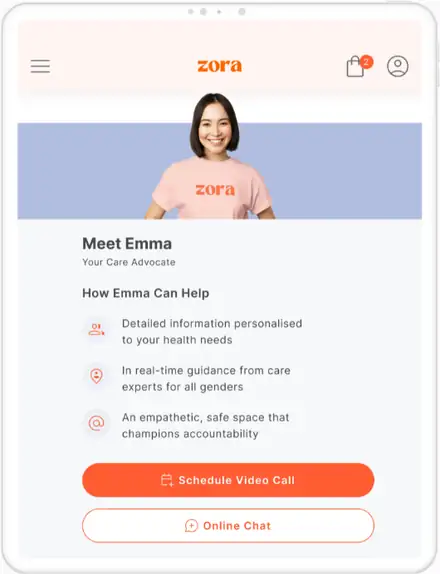
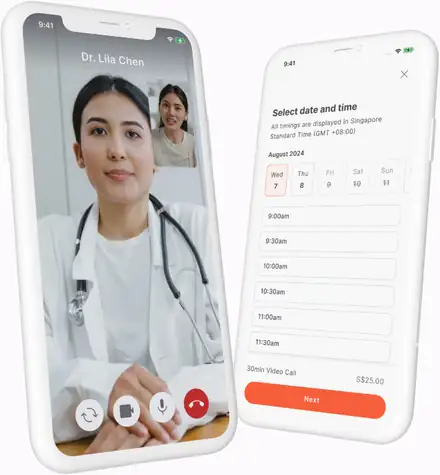
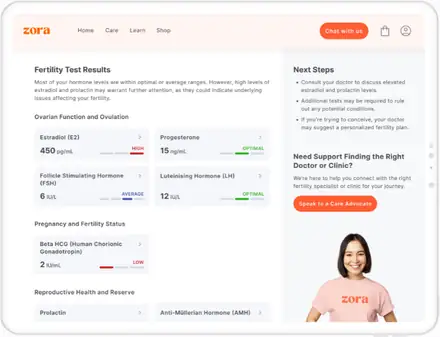
Employees join the Zora app with a company code, or single sign-on for larger teams. They can learn about fertility and egg freezing, understand what your benefit covers, book a confidential care navigation call and find partner clinics and specialists.
For HR
- Kick-off, week 1. Agree goals, countries and which employees are eligible.
- Policy and benefit design, weeks 2 to 4. Draft or update your fertility policy using our templates.
- Launch, typically weeks 4 to 6. A launch talk for employees and managers, plus a communications pack for HR to send.
- Live support. Employees book care navigation calls and use the Zora app.
- Reporting, every 3 months, on the Complete programme. Anonymised usage, common themes and our recommendations, reviewed with your account manager.
Privacy
Employee privacy is central to our programmes. On the Complete programme, routine employer reports contain aggregated engagement and utilisation information, with safeguards to prevent identification of individual employees. On every programme, personal health information is not included in standard HR reporting, and employees can get help without telling their manager. Where eligibility checks or claims administration need individual-level data, access is limited to authorised parties for defined purposes, as agreed in writing before launch. Employee data is handled in line with Singapore’s Personal Data Protection Act and Serbia’s Law on Personal Data Protection (2018), which is largely harmonised with the GDPR and treats health data as a special category of personal data.
Clinics and doctors in Serbia
Zora’s clinic and doctor directory does not list providers in Serbia yet. It lists 421 clinics and 1,185 doctors across 25 countries, mostly in Asia Pacific and the Middle East (browse clinics or browse doctors). Employees in Serbia can still use Zora’s education and the Zora app. Ask us how your team in Serbia would use Zora before you launch. See Zora’s employer guides for every country.
Rules and eligibility in Serbia
Who can use assisted reproduction
Under Article 25 of the Law on Biomedically Assisted Fertilisation (Official Gazette 40/2017 and 113/2017), adult women and men who are married or live together as unmarried partners may have treatment. As an exception, an adult woman who lives alone may also have treatment (Ministry of Health, consolidated text). Article 25 refers to a woman and a man.
Unpaid, anonymous donation; surrogacy prohibited
Offering or giving eggs, sperm or embryos for money or other gain is prohibited (Article 32), and donors are anonymous (Article 36). The law prohibits involving a woman who intends to hand the child to someone else after birth (Article 49), and Article 66 makes this a criminal offence carrying 3 to 10 years in prison (Law on Biomedically Assisted Fertilisation). Since December 2022, RFZO has paid to import donor cells (Danas, November 2022).
Fertility preservation and storage limits
Article 50 allows people at medical risk of becoming infertile to store their eggs, sperm or tissue, and Article 51 limits storage of sperm, eggs and early embryos to 5 years, extendable by up to 5 more on medical grounds; the limit does not apply to material stored under Article 50, which may be kept indefinitely (Law on Biomedically Assisted Fertilisation). By November 2023, about 500 people with cancer had frozen reproductive material at RFZO’s cost (021.rs). The law does not address elective egg freezing; private clinics offer it at the patient’s cost, and RFZO does not fund it (BB Clinic, 2026).
Maternity, childcare and paternity leave
Maternity and childcare leave together last 365 days from the start of maternity leave (Labour Law, Article 94), or 2 years for a third or later child (Article 94a) (Labour Law, consolidated text; Biznis.rs, January 2022). The state pays 100% of average earnings over the previous 18 months, generally capped at 5 average monthly salaries, and dismissal during pregnancy or these leaves is void where the employer knew of the pregnancy or leave, or was told within 30 days (Boundless, 2026). There is no separate paternity leave: Article 77 gives paid leave for a wife’s childbirth, marriage and other family events, up to 5 working days a year in total (Labour Law; Kurir Biznis, October 2026). The law has no fertility or IVF leave.
Discrimination and health data
The Law on the Prohibition of Discrimination bans discrimination on grounds including sex, health, and marital and family status (Article 2), including in employment (Article 16), and covers pregnancy, maternity leave and childcare leave under gender discrimination (Article 20) (Official Gazette 22/2009 and 52/2021). The 2018 Law on Personal Data Protection, largely harmonised with the GDPR, treats health data as a special category (DLA Piper).
Why employers choose Zora
Companies including Hilton, LinkedIn, Sanofi, HSBC, Mastercard, Carousell and Singapore Management University work with Zora Health. We work alongside your existing insurance, helping employees use the cover they already have and find suitable specialists based on their needs.
Trying to conceive with a heavy workload took a toll on my husband and me. It helped us understand our options.
Questions HR teams ask us
Is fertility leave mandatory in Serbia?
No. The Labour Law has no fertility or IVF leave. Employees use annual leave, sick leave where a doctor certifies it, or days the employer grants. Article 77 gives up to 5 working days of paid leave a year for family events, including a wife’s childbirth, but nothing for treatment appointments.
Does the state pay for IVF in Serbia?
Yes, for insured women under 45. RFZO, the state health insurance fund, pays for unlimited stimulated cycles and frozen embryo transfers for a couple’s first child, 2 stimulated cycles and 3 frozen transfers for a second child, up to 3 donor-cell cycles with 3 frozen transfers, and 3 donor-sperm cycles with 3 frozen transfers for a single woman with no child. A commission must approve each case, and treatment takes place in state hospitals or contracted private clinics.
Can employees freeze their eggs in Serbia?
Yes, with limits. The 2017 law expressly provides for storing eggs only for people at medical risk of infertility (Article 50), and RFZO pays for people with cancer. The law does not address elective egg freezing, but private clinics offer it at the patient’s cost; one private clinic lists freezing with up to 5 years of storage at RSD 70,000, plus egg retrieval and drugs. Eggs stored for medical reasons can be kept indefinitely; other stored eggs are limited to 5 years, extendable by up to 5 more on medical grounds (Article 51).
Does Zora replace our health insurance?
No. Zora works alongside your insurance. We help employees understand their options, find suitable specialists and use the cover they already have.
How much does a fertility benefit cost an employer?
It depends on the allowance, eligibility and expected uptake. Use the budget planner on this page for a first estimate, then ask us for a tailored proposal based on your headcount and countries.
How quickly can we launch?
Typically 4 to 6 weeks from contract to launch, depending on scope and countries. Most companies start with a single talk.
Related guides for Serbian employers
Build a fertility benefit for your team
Whether you are introducing fertility benefits for the first time or improving an existing programme, tell us your headcount, countries and priorities. We will come back within two working days with suitable services, an indicative budget and a practical rollout plan for your Serbian team. No obligation.
Not ready to talk yet? Explore how Zora works
Sources
- Statistical Office of the Republic of Serbia, Births and deaths, 2025 (final data), July 2026
- Statistical Office of the Republic of Serbia, Births and deaths, Vital statistics 2024 (revised), July 2025
- Statistical Office of the Republic of Serbia, Labour Force Survey, Q4 2025, February 2026
- Aon, Global Medical Trend Rates Report 2026 (copy hosted by Consultor Salud)
- 025.rs, Vantelesna oplodnja o trošku države u Srbiji, citing Tanjug, October 2026
- BB Clinic, Vantelesna oplodnja o trošku države (RFZO), kompletan vodič 2026
- 021.rs, Operacije katarakte i vantelesna oplodnja i ove godine u privatnim klinikama o trošku RFZO, February 2024
- Ozon, RFZO proširuje mrežu privatnih klinika za vantelesnu oplodnju, April 2026
- 021.rs, Do sada 59 trudnoća nastalih vantelesnom oplodnjom od uvezenog reproduktivnog materijala, citing Tanjug, November 2023
- Danas, Direktorka RFZO: država će plaćati šest pokušaja VTO sa doniranim reproduktivnim materijalom, November 2022
- 021.rs, Na snagu stupila odluka o vantelesnoj oplodnji, granica pomerena na 45 godina, July 2022
- Biznis.rs, Ko ima pravo na vantelesnu oplodnju o trošku države, May 2022
- N1, Vantelesna oplodnja i doniranim ćelijama iz inostranstva, postupak 7.000 evra, November 2022
- Intermedicus BIS, Cenovnik usluga, updated June 2026
- Law on Biomedically Assisted Fertilisation, Official Gazette 40/2017 and 113/2017, Ministry of Health
- Rašević and Sedlecky, Infertility and assisted reproductive technologies in Serbia, Stanovništvo, 2022
- Biznis.rs, Pojedine odredbe Zakona o radu štite roditeljstvo, January 2022
- Boundless, Maternity, paternity and parental leave in Serbia, 2026
- Kurir Biznis, Kako ostvariti pravo na plaćene slobodne dane (Labour Law Article 77), October 2026
- Law on the Prohibition of Discrimination, Official Gazette 22/2009 and 52/2021, Commissioner for the Protection of Equality
- DLA Piper, Data Protection Laws of the World: Serbia
- UniCredit, Annual Report 2022, IVET fertilisation: offering IVF benefits to our employees
- Deutsches IVF-Register, Jahrbuch 2024, edition for couples
- RFZO, Pravilnik o sadržaju i obimu prava na zdravstvenu zaštitu iz obaveznog zdravstvenog osiguranja i o participaciji za 2022. godinu, Official Gazette 24/2022
- Labour Law (Zakon o radu), consolidated text, Paragraf
- Ferring Pharmaceuticals, Fertility Matters at Work and This Can Happen, workplace fertility survey, November 2025
- Carrot Fertility, Global Fertility at Work report, 2023
- Gallup, This fixable problem costs US businesses $1 trillion, 2019
- World Health Organization, 1 in 6 people globally affected by infertility, April 2023
Information on this page is correct as of 5 November 2026. Laws, public funding, insurance rules and treatment costs change often, so check current rules with the relevant authority, insurer or a qualified adviser before making decisions. This page is general information, not legal, financial, tax or medical advice.