
Zora Health / Employer guide / South Korea
Support employees through fertility treatment, and keep the talent you have invested in.
Fertility treatment rarely fits around a work calendar, and most employees go through it quietly, often while doing some of their best work. Zora Health helps you build practical fertility support, from policies and manager guidance to confidential care navigation and access to 128+ partner clinics in 16 countries, around your workforce and budget. Companies including Hilton, LinkedIn, Sanofi, HSBC, Mastercard, Carousell and Singapore Management University work with us.
Book an employer consultation Explore the cost calculator
Five things South Korea HR leaders should know
- About 1 in 5 babies born in South Korea in 2025 (19.2%, or 48,981 births) was conceived with government-supported infertility treatment, up from about 1 in 7 in 2024.
- Employees get 6 days of infertility treatment leave a year by law. The first 2 are paid, rising to 4 paid days from 27 November 2026.
- National Health Insurance covers IVF and IUI at a 30% co-pay for up to 25 procedures per childbirth, and a government subsidy pays part of the rest.
- Elective egg freezing costs ₩3 million to ₩5 million a cycle. There is no national subsidy for it; Seoul pays half, up to ₩2 million.
- 4 in 10 female employees going through infertility treatment resigned, in a 2021 Korean Women’s Development Institute study.
Why fertility is a business problem for employers
Fertility treatment does not fit around a work calendar. A clinic sets the date of a scan the day before. Egg collection happens when the body is ready, usually about 36 hours after a final trigger injection. Then comes a two-week wait, and for many couples, another cycle. Your team feels it: missed meetings, unexplained absences, a strong performer who suddenly goes quiet.
Most employees hide treatment because they fear being seen as less committed. That is why the cost stays invisible in your reports. It shows up instead as:
- Resignations. 4 in 10 female wage workers going through infertility treatment resigned, many after running out of leave, according to a 2021 Korean Women’s Development Institute study reported by Asia Business Daily.
- Lower performance. 55% of 5,000 people surveyed in Canada, India, Mexico, the UK and the US for Carrot’s 2023 Global Fertility at Work report said fertility challenges hurt their work performance.
- Men too. 300,401 people were treated for infertility in 2024, up 31.4% from 2020, and 108,358 of them were men (National Health Insurance Service via The Korea Herald). A benefit written only for women misses a third of the people who need it.
- Unequal treatment. An employee in Seoul can get half her egg freezing costs back, up to ₩2 million. A colleague in Gyeonggi qualifies only with an income test and low ovarian reserve, and support in other regions varies or is unavailable.
What employers gain
Keep the people you spent the most to develop
Replacing an employee costs one-half to two times their annual salary, according to Gallup. Korean mothers were 33.8 on average at childbirth in 2025 (National Data Office), and 40.3% of infertility treatment patients were in their 40s by 2024, up from 25.5% five years earlier (The Korea Herald). A written policy, paid time off and a funded allowance can help address barriers that contribute to employee attrition.
Stand out in a tight labour market
73% of employees with fertility challenges in Ferring’s 2025 five-country survey said they would be attracted to a role that offers fertility support, and 65% of people in Carrot’s 2023 five-country survey said they would change jobs for fertility benefits. Korean employers already compete on it: in 2023, SK hynix paid ₩500,000 per procedure with no cap on procedures plus 5 days of paid leave, and CJ offered up to 6 months of paid leave for IVF. Naver gives up to 6 months of leave and ₩2 million.
Make fertility support financially predictable
A fertility benefit does not need to mean unlimited medical coverage. Employers can set annual or lifetime allowances, decide which treatments qualify, and provide guidance and education so employees understand their options before they spend. WTW projects medical costs in South Korea to rise 13.5% in 2026.
Because insurance and the government subsidy already pay much of IVF, Zora helps employers point an allowance at the gaps: elective egg freezing, storage, non-covered items and the co-pay. HR runs the programme within an agreed budget.
Want to see what this would look like for your South Korea workforce?
What IVF costs, and what the state pays
National Health Insurance covers infertility treatment. Since February 2024 the limit has been 25 procedures: 20 IVF cycles, fresh or frozen, and 5 IUI. From November 2024 that limit applies per childbirth, and the co-pay is 30% at every age (Ministry of Health and Welfare via SBS Biz).
| Treatment | Typical cost | What the patient pays |
|---|---|---|
| Fresh IVF cycle | About ₩1.5 million to ₩4 million before insurance | About ₩750,000 to ₩1.2 million at the 30% co-pay, before the government subsidy |
| Elective egg freezing | ₩3 million to ₩5 million a cycle, up to ₩6 million with drugs | The full cost. Not insured, and 2 to 3 cycles are common. |
| Egg storage | ₩300,000 to ₩500,000 a year | The full cost |
IVF costs: Banksalad, July 2026, citing Health Insurance Review and Assessment Service fee data; treat as a guide. Egg freezing: Etoday, May 2026. Storage: Kormedi, August 2025.
| Item | Public support | What the employee still carries |
|---|---|---|
| National Health Insurance | 30% co-pay for up to 25 procedures per childbirth | The co-pay, non-covered items and procedures beyond the limit |
| Government infertility subsidy | Per cycle, up to ₩1.1 million for fresh IVF, ₩500,000 for frozen and ₩300,000 for IUI, for married and de facto couples with a diagnosis | Costs above the subsidy |
| Medical fertility preservation (from 2025) | 50% of costs, up to ₩2 million for women, when treatment such as chemotherapy is expected to cause infertility (Asia Business Daily, 2025) | Elective egg freezing is not included |
| Seoul egg freezing subsidy | 50% of costs, up to ₩2 million once, for Korean women aged 20 to 49 living in Seoul for 6 months or more (women in their 20s must also meet a low ovarian reserve test) | The rest, and everything for employees outside Seoul |
| Time off for appointments | 6 days of infertility treatment leave a year, 2 paid (4 paid from 27 November 2026) | Any days beyond 6, from annual or unpaid leave |
Sources: Seoul Metropolitan Government, October 2024, Asia Business Daily on fertility preservation, April 2025 and Kyunghyang Shinmun on Seoul egg freezing, February 2024.
Age is one of the strongest predictors of IVF success, alongside individual medical and treatment factors. In 2022, 43.8% of fresh IVF procedures led to a pregnancy for women aged 25 to 29, against 20.5% for women aged 40 to 44.
The Health Insurance Review and Assessment Service reports 42.9% for women aged 30 to 34, 37.5% for 35 to 39 and 4.5% for 45 and above. These are pregnancy rates, so live birth rates are lower. The average patient was 37.9, and many couples need more than one cycle, which is why the size of an allowance, and when employees can use it, matter as much as whether you offer one.
Give Employees Access to Fertility Specialists Across Asia
Help employees navigate fertility care with access to doctors and clinics, treatment information, and clear guidance on IVF, egg freezing and other fertility options. Employees can explore their options privately, without needing to go through HR.
Fertility clinics in South Korea on the Zora app include M Fertility Center, CHA Seoul Fertility Center and Maria Fertility Hospital.
Fertility support that fits your workforce and budget
You do not need to overhaul your existing health insurance to support employees through fertility treatment. Start with awareness and manager education, add confidential one-to-one support, or introduce a funded allowance across your offices. There is no minimum company size.
Where included in the employer programme, eligible employees can use talks and care navigation without paying Zora a separate fee. Care navigation allowances are set in each proposal. Treatment and other third-party costs are paid separately, either by employees or through the fertility allowance their employer provides.
Companies starting the conversation
Essentials
Expert-led talks for employees and managers, fertility and menopause policy templates, manager guides and full access to the Zora app. Up to 2 talks a year.
Employees supported one to one
Navigation
Everything in Essentials, plus confidential one-to-one care navigation and access to our partner clinic network.
Large teams across Asia
Complete
Everything in Navigation, plus quarterly anonymised reporting, a dedicated account manager and scheduled review meetings with HR.
Optional add-ons can be added to any programme, subject to availability: hormone and fertility diagnostics and telehealth with specialists. Pricing is tailored to your headcount, your countries and the services you choose. Most companies start with a single talk.
Request a proposal See how Zora works for employers
Comparing fertility benefit providers? Use our RFP question bank
Most RFP templates were written for the US. Ours has 40 questions written for Asia, with why each one matters, what a good answer looks like and a scoring sheet for three providers. Six of the questions for South Korea:
- Which cities in South Korea can our employees use the programme in, and which clinics in each?
- Are local-plan employees covered, or only staff on international health plans?
- How does an employer benefit sit alongside National Health Insurance, the 25-procedure limit and the government infertility subsidy?
- How does the programme fit with the 6 days of statutory infertility leave and the duty to keep it confidential?
- Do you require an infertility diagnosis before support starts, and are male employees covered?
- What individual-level data does HR see, and how is consent handled under South Korea’s Personal Information Protection Act?
Your download link appears here as soon as you submit. Zora Health may contact you about employee benefits; see our privacy policy.
Plan your fertility benefit budget
Fertility benefit budget planner
Model the annual claims budget for a fertility allowance. Change any number.
This is a claims budget, not a Zora quotation. Zora’s programme fees, implementation and optional services are separate.
Illustration only. Utilisation is an editable assumption, not observed Zora data. The calculation assumes each user claims their full annual allowance, and excludes programme fees and setup costs. For a tailored model, request an employer proposal.
Estimate the potential workforce impact of fertility challenges
A rough planning scenario. It applies a global infertility estimate to your headcount, so it is not a prediction for your workforce, a measured loss or a forecast of savings from any programme.
Range: ₩225,500,000 to ₩638,000,000 a year, depending on replacement cost.
Assumptions: infertility affects about 1 in 6 adults (World Health Organization, 2023), applied to employees aged 25 to 44. Replacing an employee costs one-half to two times their annual salary (Gallup, 2019); the headline uses the low end. Absence is valued at salary divided by 250 working days. Exit rate and days lost are your own assumptions.
This is a hypothetical cost scenario, not a prediction of actual employee departures, an estimate of Zora’s financial impact or a guaranteed saving from fertility benefits.
Already have corporate health insurance? Here is where Zora fits
Your medical plan may cover some consultations and tests, but fertility treatment is often limited or excluded, so check your policy wording. Employees still need to understand their options, the public funding they qualify for and which clinic suits them.
Zora works alongside your existing insurance and benefits. We help employees get reliable information, navigate their care options and reach suitable specialists, and we give HR manager guidance, policy templates and, on the Complete programme, anonymised reporting. You strengthen fertility support without replacing your medical plan.
How Zora works
For your employees
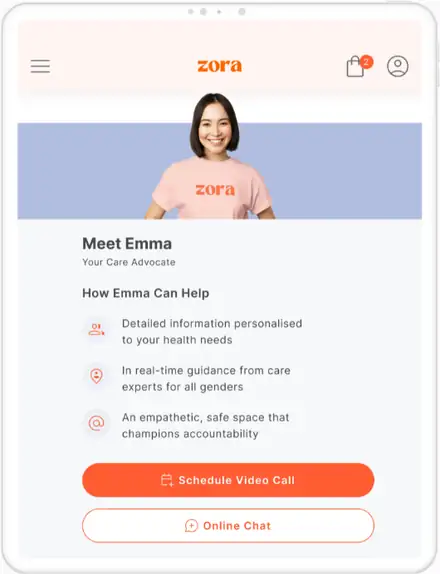
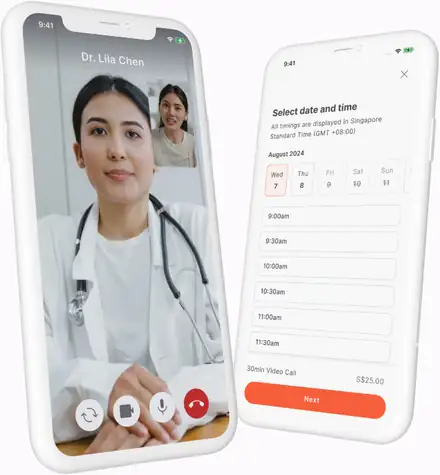
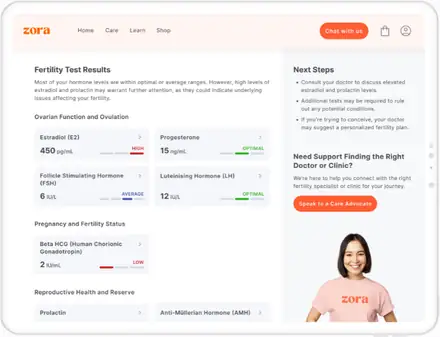
Employees join the Zora app with a company code, or single sign-on for larger teams. They can learn about fertility and egg freezing, understand what your benefit covers, book a confidential care navigation call and find partner clinics and specialists.
For HR
- Kick-off, week 1. Agree goals, countries and which employees are eligible.
- Policy and benefit design, weeks 2 to 4. Draft or update your fertility policy using our templates.
- Launch, typically weeks 4 to 6. A launch talk for employees and managers, plus a communications pack for HR to send.
- Live support. Employees book care navigation calls and use the Zora app.
- Reporting, every 3 months, on the Complete programme. Anonymised usage, common themes and our recommendations, reviewed with your account manager.
Privacy
Employee privacy is central to our programmes. On the Complete programme, routine employer reports contain aggregated engagement and utilisation information, with safeguards to prevent identification of individual employees. On every programme, personal health information is not included in standard HR reporting, and employees can get help without telling their manager. Where eligibility checks or claims administration need individual-level data, access is limited to authorised parties for defined purposes, as agreed in writing before launch. Employee data is handled in line with Singapore’s Personal Data Protection Act and South Korea’s Personal Information Protection Act, which requires separate consent for health information.
Clinics and doctors in South Korea
Zora’s directory lists 9 clinics and 31 doctors in South Korea. Locations include Seoul and Incheon. Of these clinics, 6 list IVF and 6 list egg freezing.
Employees can browse clinics in South Korea, see IVF clinics and find a doctor in South Korea on the Zora app. The directory is for information only and is not an endorsement. See Zora’s employer guides for every country.
Rules and eligibility in South Korea
Infertility treatment leave
Under the Equal Employment Opportunity and Work-Family Balance Assistance Act, employees get 6 days of infertility treatment leave a year. Since 23 February 2025 the first 2 are paid (Kyunghyang Shinmun), and from 27 November 2026 the first 4 are paid, with a higher government pay cap for small and medium firms (Ministry of Employment and Labor via SBS Biz). The cap on infertility leave pay rises from ₩168,420 to ₩336,840 on the same date (SBS Biz, 2026). Employers must not treat workers unfavourably for using it and must keep leave requests confidential, and from 27 November 2026 unfavourable treatment can bring up to 3 years in prison or a fine of up to ₩30 million (SBS Biz, 2026).
Maternity, spouse and parental leave
Women get 90 days of maternity leave, or 120 for multiple births. Spouses get 20 days of paid childbirth leave. Parental leave runs to 1.5 years per parent when both take at least 3 months, and pregnant workers can cut 2 hours a day without loss of pay in the first 12 weeks or from week 32.
Embryos and consent
Creating an embryo needs the written consent of both spouses, and embryos are normally discarded 5 years after creation (Kyungbuk Maeil).
Who can use assisted reproduction
No law bans treatment for single women, but the Korean Society of Obstetrics and Gynecology’s ethics guideline limits IVF to married and de facto couples (Asia Business Daily; Daily Medi, 2024). A 2024 bill on support for unmarried women was under committee review in December 2024 (Daily Medi). Single women can freeze their eggs (Korea Times, 2023), and there is no statutory limit on egg storage.
Surrogacy
No Korean statute regulates surrogacy, and there is no legal framework for altruistic arrangements. Paid arrangements are prosecuted: transferring a child for money breaches the Child Welfare Act, and paying for eggs, sperm or embryos breaches the Bioethics and Safety Act (Korea Herald, 2024). Courts treat the woman who gives birth as the legal mother rather than the genetic parents (Korea Herald, 2018), so intended parents have no automatic parental status.
Why employers choose Zora
Companies including Hilton, LinkedIn, Sanofi, HSBC, Mastercard, Carousell and Singapore Management University work with Zora Health. We work alongside your existing insurance, helping employees use the cover they already have and find suitable specialists based on their needs.
Trying to conceive with a heavy workload took a toll on my husband and me. It helped us understand our options.
Questions HR teams ask us
Is infertility leave mandatory in South Korea?
Yes. Employees can take 6 days of infertility treatment leave a year. The first 2 days are paid, rising to 4 paid days from 27 November 2026, and employers must keep the leave confidential.
Does National Health Insurance cover IVF?
Yes. IVF and IUI are covered at a 30% co-pay for up to 25 procedures per childbirth, and a government subsidy pays part of the remaining cost for eligible couples.
Can a single employee use a company egg freezing benefit?
Yes. Elective egg freezing is lawful for unmarried women. Using the eggs in IVF is currently limited to married and de facto couples under medical guidelines.
Does Zora replace our health insurance?
No. Zora works alongside your insurance. We help employees understand their options, find suitable specialists and use the cover they already have.
How much does a fertility benefit cost an employer?
It depends on the allowance, eligibility and expected uptake. Use the budget planner on this page for a first estimate, then ask us for a tailored proposal based on your headcount and countries.
How quickly can we launch?
Typically 4 to 6 weeks from contract to launch, depending on scope and countries. Most companies start with a single talk.
Related guides for South Korea employers
Build a fertility benefit for your team
Whether you are introducing fertility benefits for the first time or improving an existing programme, tell us your headcount, countries and priorities. We will come back within two working days with suitable services, an indicative budget and a practical rollout plan for your South Korea team. No obligation.
Not ready to talk yet? Explore how Zora works
Sources
- National Data Office, 2025 birth statistics, via Financial News, August 2026
- KIHASA infertility data cited in National Assembly bill 2201210, July 2024
- The Korea Herald, infertility patients, October 2025
- The Korea Herald via The Star, births through infertility treatment, January 2026
- Asia Business Daily, HIRA infertility treatment statistics, March 2025
- Asia Business Daily, Korean Women’s Development Institute study on resignations, October 2024
- Twig24, National Health Insurance cover for infertility, June 2024
- SBS Biz, infertility support per childbirth, November 2024
- Seoul Metropolitan Government, infertility support, October 2024
- Asia Business Daily, fertility preservation support, April 2025
- Kyunghyang Shinmun, Seoul egg freezing support, February 2024
- Kyunghyang Shinmun, Gyeonggi infertility support, March 2026
- Banksalad, IVF costs and government support, July 2026
- Etoday, egg freezing costs, May 2026
- Kormedi, egg storage, August 2025
- Kyungbuk Maeil, embryo storage rule, July 2025
- Daily Medi, assisted reproduction for unmarried women, December 2024
- Kyunghyang Shinmun, leave changes from February 2025
- SBS Biz, paid infertility leave from November 2026, August 2026
- Lockton, South Korea expands family leave entitlements
- Securiti, South Korea Personal Information Protection Act summary
- WTW, Global Medical Trends Survey, November 2025
- OECD via FRED, female labour force participation, South Korea
- Korea JoongAng Daily, companies encourage workers to have babies, April 2023
- Asia Business Daily, Naver infertility leave, August 2024
- BizWatch, department store fertility support, January 2024
- Ferring Pharmaceuticals, Fertility Matters at Work and This Can Happen, workplace fertility survey, November 2025
- Carrot Fertility, Global Fertility at Work report, 2023
- Gallup, This fixable problem costs US businesses $1 trillion, 2019
- Maeil Shinmun, births through government-supported infertility treatment in 2025, October 2026
- Korea Herald (via The Star), Four individuals face charges over illegal surrogacy 13 years ago, September 2024
- Korea Herald, Seoul Family Court ruling on surrogate birth mother, May 2018
- Korea Times, Seoul egg freezing support draws single women, October 2023
- Hankyung, infertility treatment births 2025, May 2026
- Seoul Metropolitan Government, egg freezing support conditions
- Asia Business Daily, KSOG guideline on unmarried women, April 2025
- World Health Organization, 1 in 6 people globally affected by infertility, April 2023
Information on this page is correct as of 5 November 2026. Laws, public funding, insurance rules and treatment costs change often, so check current rules with the relevant authority, insurer or a qualified adviser before making decisions. This page is general information, not legal, financial, tax or medical advice.