
Zora Health / Employer guide / Sweden
Support employees through fertility treatment, and keep the talent you have invested in.
Fertility treatment rarely fits around a work calendar, and most employees go through it quietly, often while doing some of their best work. Zora Health helps you build practical fertility support, from policies and manager guidance to confidential care navigation and access to 128+ partner clinics in 16 countries, around your workforce and budget. Companies including Hilton, LinkedIn, Sanofi, HSBC, Mastercard, Carousell and Singapore Management University work with us.
Book an employer consultation Explore the cost calculator
Five things Swedish HR leaders should know
- Sweden’s total fertility rate was 1.42 children per woman in 2025, down from 1.43 in 2024, with 97,500 births (SCB).
- Regions fund up to 3 IVF attempts for a first shared child if treatment starts before the woman’s 40th birthday and the partner’s 56th. Waits can reach 2 years in some regions.
- In 2026 the government gave regions SEK 327 million to offer up to 3 more attempts where medically justified.
- Parental benefit is 480 days per child, with 90 reserved for each parent. There is no statutory fertility leave.
- Egg freezing, treatment for a second child and private cycles cost about SEK 37,000 to 50,000 each.
Why fertility is a business problem for employers
Fertility treatment does not fit around a work calendar. A clinic sets the date of a scan the day before. Egg collection happens when the body is ready, usually about 36 hours after a final trigger injection. Then comes a two-week wait, and for many couples, another cycle. Your team feels it: missed meetings, unexplained absences, a strong performer who suddenly goes quiet.
The World Health Organization estimates that about 1 in 6 people worldwide are affected by infertility, and the Swedish government puts involuntary childlessness at about 1 in 6 couples (Regeringen, May 2026). We found no Swedish survey on how many employees keep treatment from their employer. In a 2023 Carrot Fertility survey of 5,000 people in Canada, India, Mexico, the UK and the US, 79% felt uncomfortable discussing fertility at work.
- Resignations. 39% of employees with fertility challenges in Ferring‘s 2025 survey of more than 3,600 people in Australia, France, Japan, Poland and the UK had left or considered leaving their job during treatment.
- Queues. Where a region includes IVF in the care guarantee the wait is about 3 months; elsewhere it can be up to 2 years (1177).
- Insurance terms. In June 2026 the Equality Ombudsman (DO) found that an insurer discriminated against a woman on grounds of sex by refusing her claim under a term excluding pregnancy-related conditions, and asked it to pay her SEK 45,000 (DO, June 2026).
What employers gain
Keep the people you spent the most to develop
Replacing an employee costs one-half to two times their annual salary, according to Gallup. 73.3% of Swedish women aged 15 to 74 were in the labour force in 2025 (SCB). A written policy, paid time off and a funded allowance remove some of the reasons people leave.
Stand out in a tight labour market
73% of employees with fertility challenges said they would be attracted to a role that offers fertility support (Ferring, 2025), and 65% said they would change jobs for fertility benefits (Carrot, 2023). Since 2021, Stockholm-based Spotify has offered every full-time employee worldwide a family-forming allowance that can cover fertility preservation (Euronews, July 2024).
Make fertility support financially predictable
Aon’s 2026 report, published in October 2025, projected a 13% gross rise in employer medical plan costs in Sweden for 2026, against 5% projected for 2025 (Aon; full report via ConsultorSalud). A capped allowance sets a ceiling on fertility spending.
Zora helps employers structure benefits around local treatment costs, regional funding rules and the law, so HR can run the programme within an agreed budget.
Want to see what this would look like for your Swedish workforce?
What IVF costs, and what the state pays
Sweden’s 21 regions fund fertility care under a 2022 recommendation from SKR, the association of regions: up to 3 IVF attempts with egg collection if medically justified, starting before the woman’s 40th birthday and the partner’s 56th, with remaining frozen embryos transferable until she turns 45 (SKR recommendation 14/2022). Stockholm and Skåne accept women aged 25 to 39 and men aged 25 to 55; Västra Götaland accepts women up to 39 and men up to 55 (1177 Stockholm, 1177 Skåne, 1177 Västra Götaland). Patient fees are capped by the high-cost protection at SEK 1,450 for outpatient visits (1177) and SEK 3,800 for prescription medicines over 12 months (1177).
| Item | Price (SEK) | Notes |
|---|---|---|
| IVF, private clinic | From 49,000 | Stockholm IVF |
| IVF or ICSI, self-funded at a university hospital | 44,900 | Akademiska, Uppsala |
| Frozen embryo transfer | 14,800 | Akademiska |
| IVF with donor sperm | 56,900 to 59,000 | Akademiska; Stockholm IVF from 59,000 |
| Elective egg freezing, one cycle | From 37,000 | Stockholm IVF; about 30,000 plus 10,000 to 15,000 medication (Dagens PS, 2025) |
| Egg storage, per year | About 3,000 to 4,000 | Dagens PS, 2025 |
Sources: Stockholm IVF prices on Vården.se, 2026; Akademiska sjukhuset, self-funded price list valid from 10 January 2025; Dagens PS, May 2025. Rounded; clinics set their own fees.
| Item | Public support (or own savings) | What the employee still carries |
|---|---|---|
| IVF attempts 1 to 3, first shared child, started before age 40 | Regional funding | Patient fees up to the high-cost caps, and time off |
| Attempts 4 to 6 in 2026 | State grant to regions; Stockholm and Skåne offer them from 1 August to 31 December 2026, mainly to patients treated by the region in the past 2 years | Only if the clinic judges more attempts worthwhile; otherwise about SEK 45,000 to 50,000 per private attempt |
| Treatment for a second shared child, or started from age 40 | None under the standard rules (own savings) | The full price; Skåne charges SEK 58,500 for IVF with donor sperm |
Sources: SKR, 2022; Regeringen, May 2026; Socialstyrelsen grant allocation, June 2026; 1177 Skåne; 1177 Stockholm.
Age is one of the strongest predictors of IVF success. For treatment started in 2023, the delivery rate per fresh embryo transfer with own gametes was 27.0% overall, 38.4% for women under 30, 17.9% at 38 to 39 and 7.7% at 42 or older (Q-IVF Annual Report 2025).
An employee who starts in her late 30s has little time to use her funded attempts, so the size of an allowance, and when employees can use it, matter as much as whether you offer one.
Give Employees Access to Fertility Specialists
Help employees navigate fertility care with access to doctors and clinics, treatment information, and clear guidance on IVF, egg freezing and other fertility options. Employees can explore their options privately, without needing to go through HR.
Fertility support that fits your workforce and budget
You do not need to overhaul your existing health insurance to support employees through fertility treatment. Start with awareness and manager education, add confidential one-to-one support, or introduce a funded allowance across your offices. There is no minimum company size.
Where included in the employer programme, eligible employees can use talks and care navigation without paying Zora a separate fee. Care navigation allowances are set in each proposal. Treatment and other third-party costs are paid separately, either by employees or through the fertility allowance their employer provides.
Companies starting the conversation
Essentials
Expert-led talks for employees and managers, fertility and menopause policy templates, manager guides and full access to the Zora app. Up to 2 talks a year.
Employees supported one to one
Navigation
Everything in Essentials, plus confidential one-to-one care navigation and access to our partner clinic network.
Large and multi-country teams
Complete
Everything in Navigation, plus quarterly anonymised reporting, a dedicated account manager and scheduled review meetings with HR.
Optional add-ons can be added to any programme, subject to availability: hormone and fertility diagnostics and telehealth with specialists. Pricing is tailored to your headcount, your countries and the services you choose. Most companies start with a single talk.
Request a proposal See how Zora works for employers
Comparing fertility benefit providers? Use our RFP question bank
Our RFP question bank has 40 questions, with why each one matters, what a good answer looks like and a scoring sheet for three providers. Six of the questions for Sweden:
- Are local-plan employees covered, or only staff on international health plans?
- Do you require an infertility diagnosis before support starts?
- How does the allowance work alongside regional funding, for example a 4th attempt, treatment for a second child or treatment that starts after the woman’s 40th birthday?
- Which clinics in Stockholm, Gothenburg and Malmö can employees use, and can the allowance pay for private treatment while an employee waits in a regional queue?
- Can the allowance pay for elective egg freezing, yearly storage and donor treatment, and how is it taxed as an employee benefit in Sweden?
- How is health data handled under the GDPR, the Data Protection Act (2018:218) and the Patient Data Act, and what aggregated information does the employer see?
Your download link appears here as soon as you submit. Zora Health may contact you about employee benefits; see our privacy policy.
Plan your fertility benefit budget
Fertility benefit budget planner
Model the annual claims budget for a fertility allowance. Change any number.
This is a claims budget, not a Zora quotation. Zora’s programme fees, implementation and optional services are separate.
Illustration only. Utilisation is an editable assumption, not observed Zora data. The calculation assumes each user claims their full annual allowance, and excludes programme fees and setup costs. For a tailored model, request an employer proposal.
Estimate the potential workforce impact of fertility challenges
A rough planning scenario. It applies a global infertility estimate to your headcount, so it is not a prediction for your workforce, a measured loss or a forecast of savings from any programme.
Range: SEK 2,255,000 to SEK 6,380,000 a year, depending on replacement cost.
Assumptions: infertility affects about 1 in 6 adults (World Health Organization, 2023), applied to employees aged 25 to 44. Replacing an employee costs one-half to two times their annual salary (Gallup, 2019); the headline uses the low end. Absence is valued at salary divided by 250 working days. Exit rate and days lost are your own assumptions.
This is a hypothetical cost scenario, not a prediction of actual employee departures, an estimate of Zora’s financial impact or a guaranteed saving from fertility benefits.
Already have corporate health insurance? Here is where Zora fits
Your medical plan may cover some consultations and tests, but fertility treatment is often limited or excluded, so check your policy wording. Employees still need to understand their options, the public funding they qualify for and which clinic suits them.
Zora works alongside your existing insurance and benefits. We help employees get reliable information, navigate their care options and reach suitable specialists, and we give HR manager guidance, policy templates and, on the Complete programme, anonymised reporting. You strengthen fertility support without replacing your medical plan.
How Zora works
For your employees
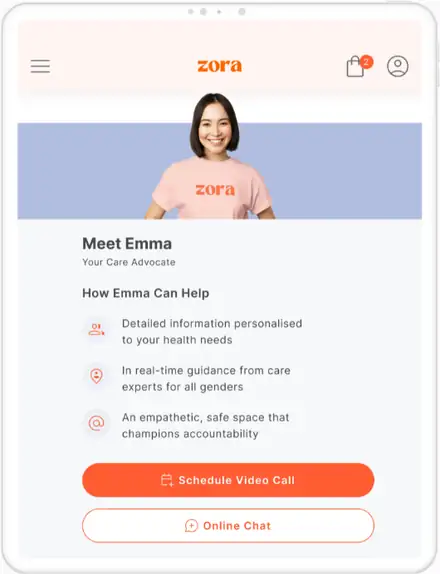
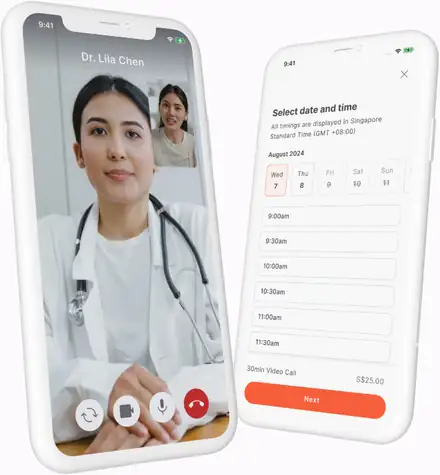
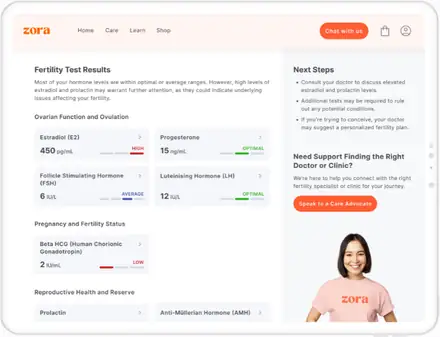
Employees join the Zora app with a company code, or single sign-on for larger teams. They can learn about fertility and egg freezing, understand what your benefit covers, book a confidential care navigation call and find partner clinics and specialists.
For HR
- Kick-off, week 1. Agree goals, countries and which employees are eligible.
- Policy and benefit design, weeks 2 to 4. Draft or update your fertility policy using our templates.
- Launch, typically weeks 4 to 6. A launch talk for employees and managers, plus a communications pack for HR to send.
- Live support. Employees book care navigation calls and use the Zora app.
- Reporting, every 3 months, on the Complete programme. Anonymised usage, common themes and our recommendations, reviewed with your account manager.
Privacy
Employee privacy is central to our programmes. On the Complete programme, routine employer reports contain aggregated engagement and utilisation information, with safeguards to prevent identification of individual employees. On every programme, personal health information is not included in standard HR reporting, and employees can get help without telling their manager. Where eligibility checks or claims administration need individual-level data, access is limited to authorised parties for defined purposes, as agreed in writing before launch. Employee data is handled in line with Singapore’s Personal Data Protection Act and Sweden’s data protection rules under the GDPR and the Data Protection Act (2018:218), which treat health data as special category data.
Clinics and doctors in Sweden
Zora’s clinic and doctor directory does not list providers in Sweden yet. It lists 421 clinics and 1,185 doctors across 25 countries, mostly in Asia Pacific and the Middle East (browse clinics or browse doctors). Employees in Sweden can still use Zora’s education and the Zora app. Ask us how your team in Sweden would use Zora before you launch. See Zora’s employer guides for every country.
Rules and eligibility in Sweden
Who can use assisted reproduction
Treatment is open to a man and a woman, two women, and, since 1 April 2016, single women; men and male couples cannot receive assisted reproduction (Riksdagen, 2016, Socialstyrelsen). Since 1 January 2019, donated embryos and double donation (donated eggs and sperm together) are allowed (Socialstyrelsen). A donor-conceived person can learn the donor’s identity once mature.
Egg freezing
Private clinics have offered elective egg freezing since 2011 (SVT, 2022); regions fund freezing only for medical reasons (Socialstyrelsen). Q-IVF recorded 865 non-medical egg freezing cycles in 2023 (Q-IVF). The law sets no storage limit for eggs, though clinics may; embryos may be stored for 10 years, with longer storage only for exceptional reasons on application to Socialstyrelsen.
Parental leave and VAB, but no fertility leave
Parental benefit is 480 days per child, 390 of them at about 80% of salary, and each parent has 90 days that cannot be transferred (Försäkringskassan). The non-birth parent gets 10 days of temporary parental benefit around the birth (Försäkringskassan). 2 weeks of leave around the birth are compulsory for the mother (Föräldraledighetslagen). VAB covers up to 120 days a year per child under 12, at slightly under 80% of income (Försäkringskassan).
Discrimination, reduced hours and patient data
The Discrimination Act bans discrimination on 7 grounds, including sex, sexual orientation and age, and requires a yearly pay survey. Employers may not treat staff unfavourably for reasons connected with parental leave, and parents may cut their hours by up to a quarter until a child turns 8 (Föräldraledighetslagen 7 and 16 §§). Clinics keep records under the Patient Data Act (2008:355), which limits access to staff involved in a patient’s care and requires logging of electronic access.
More IVF attempts and pay transparency
The government expects the IVF grant to continue after 2026 (Regeringen, April 2026). Regions apply the grant in different ways; Region Örebro, for example, raised publicly funded IVF from 3 to 6 attempts where medically justified in October 2026 (Region Örebro län via TT, October 2026). Sweden missed the 7 June 2026 deadline to implement the EU pay transparency directive: in March the government said it would not submit a bill and would seek renegotiation (Regeringen, March 2026). The European Commission refused in May, so Sweden must still implement it (KPMG, June 2026).
Surrogacy
Sweden has no specific surrogacy rules, but Swedish health care may not assist a surrogacy arrangement, so neither commercial nor altruistic surrogacy is available domestically (SOU 2021:56). The woman who gives birth is the legal mother (Parental Code, ch. 1 s. 7); a genetic father can confirm paternity and the intended mother must adopt. Proposals for children born through surrogacy abroad were left out of the 2022 parenthood reform (Riksdagen, 2022).
Why employers choose Zora
Companies including Hilton, LinkedIn, Sanofi, HSBC, Mastercard, Carousell and Singapore Management University work with Zora Health. We work alongside your existing insurance, helping employees use the cover they already have and find suitable specialists based on their needs.
Trying to conceive with a heavy workload took a toll on my husband and me. It helped us understand our options.
Questions HR teams ask us
Is fertility leave mandatory in Sweden?
No. There is no statutory fertility or IVF leave. Employees can use sick leave, annual leave or leave agreed in a collective agreement or contract, and employers can add paid fertility leave in their own policy. Parental benefit of 480 days per child starts only once a child is born or adopted.
Does the public system pay for IVF in Sweden?
Yes, through the region where the employee is registered. Following SKR’s 2022 recommendation, regions fund up to 3 IVF attempts with egg collection for couples without a shared child and single women without children, if treatment starts before the woman’s 40th birthday and the partner’s 56th. Patients pay regional fees capped by the high-cost protection. In 2026 a state grant of SEK 327 million lets regions offer up to 3 more attempts where medically justified.
Can single women and female couples get IVF in Sweden?
Yes. Female couples can receive treatment with donor sperm, and single women have had access since 1 April 2016. Regional funding for a single woman requires that she has no biological or adopted children. Elective egg freezing is legal but self-funded, from about SEK 37,000 per cycle at one Stockholm clinic in 2026.
Does Zora replace our health insurance?
No. Zora works alongside your insurance. We help employees understand their options, find suitable specialists and use the cover they already have.
How much does a fertility benefit cost an employer?
It depends on the allowance, eligibility and expected uptake. Use the budget planner on this page for a first estimate, then ask us for a tailored proposal based on your headcount and countries.
How quickly can we launch?
Typically 4 to 6 weeks from contract to launch, depending on scope and countries. Most companies start with a single talk.
Related guides for Swedish employers
Build a fertility benefit for your team
Whether you are introducing fertility benefits for the first time or improving an existing programme, tell us your headcount, countries and priorities. We will come back within two working days with suitable services, an indicative budget and a practical rollout plan for your Swedish team. No obligation.
Not ready to talk yet? Explore how Zora works
Sources
- SCB, Befolkningsstatistik helåret 2025
- SCB, Arbetskraftsundersökningarna (AKU) 2025
- SKR, Rekommendation om offentligt finansierad assisterad befruktning, meddelande 14/2022
- 1177 Stockholm, IVF provrörsbefruktning (updated July 2026)
- 1177 Västra Götaland, IVF provrörsbefruktning
- 1177 Skåne, IVF provrörsbefruktning
- Regeringen, Socialstyrelsen får uppdrag att förbereda fler IVF-försök, May 2026
- Regeringen, Vårdsatsningar i vårändringsbudgeten för 2026, April 2026
- Socialstyrelsen, Fördelning av statsbidrag 2026 för satsning på ökat antal IVF-försök, June 2026
- Q-IVF, Annual Report 2025 (treatment year 2023)
- Socialstyrelsen, Hjälp att försöka få barn: assisterad befruktning
- Socialstyrelsen, Assisterad befruktning med embryodonation och dubbeldonation
- Socialstyrelsen, Förlängd frystid för befruktade ägg
- Riksdagen, Betänkande 2015/16:SoU3 Assisterad befruktning för ensamstående kvinnor
- Akademiska sjukhuset, Prislista privatfinansierade behandlingar, valid from 10 January 2025
- Vården.se, Stockholm IVF treatments and prices, 2026
- Dagens PS, Frysta ägg: karriärens kylskåp eller arbetsgivarens nya vapen, May 2025
- SVT, Tio år sedan det blev möjligt att frysa ner sina ägg privat, September 2022
- 1177, Högkostnadsskydd för öppenvård
- 1177, Läkemedel på recept: kostnader
- Försäkringskassan, Föräldrapenning
- Försäkringskassan, 10 dagar vid barns födelse
- Försäkringskassan, Vård av barn (vab)
- Föräldraledighetslag (1995:584), lagen.nu
- Diskrimineringslag (2008:567), lagen.nu
- DO, Kvinna fick inte utnyttja sin vårdförsäkring för graviditetsrelaterade besvär, 11 June 2026
- Patientdatalag (2008:355), lagen.nu
- Lag (2018:218) med kompletterande bestämmelser till EU:s dataskyddsförordning, lagen.nu
- Regeringen, Regeringen vill omförhandla lönetransparensdirektivet, March 2026
- KPMG, Lönetransparensdirektivet: nej från EU-kommissionen till omförhandling, June 2026
- Euronews, Company-sponsored egg freezing: would you be tempted?, July 2024
- Aon, The Global Medical Trend Rates Report
- Aon, Global Medical Trend Rates Report 2026 (October 2025), full PDF as hosted by ConsultorSalud
- Risk & Insurance, Global medical trend eases to 9.0% for 2027, October 2026
- SOU 2021:56, Nya regler om utländska föräldraskap och adoption i vissa fall
- Föräldrabalk (1949:381), Sveriges riksdag
- Riksdagen, Nya regler om föräldraskap i internationella situationer, June 2022
- Region Örebro län via TT, Sex IVF-försök erbjuds, 7 October 2026
- Ferring Pharmaceuticals, Fertility Matters at Work and This Can Happen, workplace fertility survey, November 2025
- Carrot Fertility, Global Fertility at Work report, 2023
- Gallup, This fixable problem costs US businesses $1 trillion, 2019
- World Health Organization, 1 in 6 people globally affected by infertility, April 2023
Information on this page is correct as of 5 November 2026. Laws, public funding, insurance rules and treatment costs change often, so check current rules with the relevant authority, insurer or a qualified adviser before making decisions. This page is general information, not legal, financial, tax or medical advice.