
Zora Health / Employer guide / United Kingdom
Support employees through fertility treatment, and keep the talent you have invested in.
Fertility treatment rarely fits around a work calendar, and most employees go through it quietly, often while doing some of their best work. Zora Health helps you build practical fertility support, from policies and manager guidance to confidential care navigation and access to 128+ partner clinics in 16 countries, around your workforce and budget. Companies including Hilton, LinkedIn, Sanofi, HSBC, Mastercard, Carousell and Singapore Management University work with us.
Book an employer consultation Explore the cost calculator
Five things UK HR leaders should know
- The total fertility rate in England and Wales fell to 1.39 children per woman in 2025 (ONS), and about 1 in 31 UK births in 2024 came from IVF (HFEA, preliminary).
- NICE recommends 3 full NHS IVF cycles for eligible women under 40, but 29 of England’s 42 ICBs funded only one in February 2026. Scotland offers up to 3, Wales 2 and Northern Ireland 1.
- Only 28% of UK IVF cycles were NHS-funded in 2024. Self-funded IVF at two NHS-run units costs £3,675 to 4,750 a cycle; freezing and later thawing eggs averages £7,000 to 8,000 (HFEA).
- There is no legal right to paid time off for IVF, and a 2025 bill for one fell in April 2026. From April 2027, unpaid pregnancy loss leave will cover an unsuccessful IVF embryo transfer.
- A fixed annual allowance, set against private prices and local NHS gaps, keeps the employer’s budget predictable.
Why fertility is a business problem for employers
Fertility treatment runs on the clinic’s timetable. Scans are often booked a day ahead, egg collection comes about 36 hours after a trigger injection, then a two-week wait, often over several cycles.
The World Health Organization estimates that 1 in 6 people worldwide are affected by infertility. In a 2023 CIPD survey, 47% of UK employees with fertility challenges had not told their manager or HR. In a 2022 Zurich UK survey of 250 women who had recently had IVF, 58% did not feel able to tell their employer.
- Resignations. 19% of UK employees with fertility challenges had considered leaving their job because of their experience at work (CIPD, 2023); 12% of the Zurich respondents quit for lack of employer support.
- No clear time off. Only 35% of UK employers in a 2025 survey by Ferring said they gave clear entitlements for fertility appointments. Across the five countries surveyed, 60% of employees said they were not clearly entitled to time off.
- Unequal access. NHS-funded IVF cycles in 2024 ranged from 54% in Scotland to 25% in England, and from 51% in the North East to 20% in the South West and East Midlands (HFEA).
What employers gain
Keep the people you spent the most to develop
Replacing an employee costs one-half to two times their annual salary, according to Gallup. UK patients starting IVF were 34.8 on average in 2024 (HFEA), when many move into senior roles. A written policy, paid time off and a funded allowance can reduce barriers that contribute to attrition.
Stand out in a tight labour market
In Ferring’s five-country survey, 73% of employees with fertility challenges said they would be attracted to a role that offers fertility support (Ferring, 2025), and 65% of people in Carrot’s 2023 survey of Canada, India, Mexico, the UK and the US said they would change jobs for fertility benefits (Carrot, 2023). Only 27% of UK employers had a fertility treatment policy in 2023 (CIPD). From June 2026, First Bus gives five days’ paid leave for fertility treatment and two days for partners (PET BioNews).
Make fertility support financially predictable
Employers can set annual or lifetime allowances and decide which treatments qualify.
Zora structures benefits around local treatment costs, the law and workforce needs, within an agreed budget.
Want to see what this would look like for your UK workforce?
What IVF costs, and what the state pays
Each UK nation sets its own NHS fertility funding, and England’s 42 ICBs can depart from NICE guidance. Private prices for the same treatment can vary two or three times between clinics (HFEA). Self-funded prices at two NHS-run units:
| Item | Guy’s and St Thomas’ (£) | Salisbury, January 2026 (£) |
|---|---|---|
| IVF cycle | 3,675 | 4,750 (with blastocyst culture) |
| ICSI | 4,675 per cycle | 1,250 added to an IVF cycle |
| IVF or ICSI medication | 700 to 1,200 (estimate, billed separately) | Not listed |
| Frozen embryo transfer | 1,575 | 2,375 |
| IUI, per cycle | 1,200 | 1,150 |
| Egg freezing cycle | 3,300 | 4,200 (egg thawing cycle 4,000) |
| Egg storage | 350 a year | Not listed |
Sources: Guy’s and St Thomas’ Specialist Care; Salisbury NHS Foundation Trust; HFEA, egg freezing. Consultations, tests and add-ons cost extra.
| Item | Public support (or own savings) | What the employee still carries |
|---|---|---|
| IVF in England | NICE: 3 full cycles under 40 (up to 3 more considered), 1 at 40 to 41. Most ICBs fund one | Further cycles, waits, or the full price if ineligible |
| IVF in Scotland | Up to 3 full cycles; single women not currently eligible (review due early summer 2027) | Full price if ineligible; longer waits for donor eggs or sperm |
| IVF in Wales | 2 cycles under 40; 1 at 40 to 42 if no previous IVF | Any third or later cycle |
| IVF in Northern Ireland | 1 full cycle (all embryos from one egg collection) if listed from 1 October 2022 | Any further egg collection |
| Elective egg freezing | Own savings (not a subsidy) | HFEA average of £7,000 to 8,000 to freeze and later thaw, plus storage of £125 to 350 a year |
| Tax relief | We found no tax relief for fertility treatment | Not applicable |
Sources: NICE NG257, 2026; PET; Scottish Government and STV News; Fertility Network UK; Department of Health NI, 2024. BMI, smoking and existing-children rules also apply.
Age strongly predicts IVF success. In 2024, the UK birth rate per embryo transferred for IVF with patients’ own eggs (fresh and frozen transfers combined) was 38% at ages 18 to 34 and 8% at ages 43 to 44, according to preliminary, not yet validated HFEA data.
Give Employees Access to Fertility Specialists
Help employees navigate fertility care with access to doctors and clinics, treatment information, and clear guidance on IVF, egg freezing and other fertility options. Employees can explore their options privately, without needing to go through HR.
Fertility support that fits your workforce and budget
You do not need to overhaul your existing health insurance to support employees through fertility treatment. Start with awareness and manager education, add confidential one-to-one support, or introduce a funded allowance across your offices. There is no minimum company size.
Where included in the employer programme, eligible employees can use talks and care navigation without paying Zora a separate fee. Care navigation allowances are set in each proposal. Treatment and other third-party costs are paid separately, either by employees or through the fertility allowance their employer provides.
Companies starting the conversation
Essentials
Expert-led talks for employees and managers, fertility and menopause policy templates, manager guides and full access to the Zora app. Up to 2 talks a year.
Employees supported one to one
Navigation
Everything in Essentials, plus confidential one-to-one care navigation and access to our partner clinic network.
Large and multi-country teams
Complete
Everything in Navigation, plus quarterly anonymised reporting, a dedicated account manager and scheduled review meetings with HR.
Optional add-ons can be added to any programme, subject to availability: hormone and fertility diagnostics and telehealth with specialists. Pricing is tailored to your headcount, your countries and the services you choose. Most companies start with a single talk.
Request a proposal See how Zora works for employers
Comparing fertility benefit providers? Use our RFP question bank
Our RFP question bank has 40 questions, with why each one matters, what a good answer looks like and a scoring sheet for three providers. Six of the questions for the United Kingdom:
- Are local-plan employees covered, or only staff on international health plans?
- Do you require an infertility diagnosis before support starts?
- Which HFEA-licensed clinics can employees use, and is there access outside London, for example in Manchester, Birmingham, Glasgow, Cardiff and Belfast?
- How does the benefit work alongside NHS funding in each nation and ICB, for example while an employee waits for a funded cycle or after funded cycles are used?
- Can the allowance cover elective egg freezing, later thaw and transfer, and storage over the 10-year consent renewal periods?
- How is employee health data handled as special category data under the UK GDPR and the Data Protection Act 2018, and what does the employer see?
Your download link appears here as soon as you submit. Zora Health may contact you about employee benefits; see our privacy policy.
Plan your fertility benefit budget
Fertility benefit budget planner
Model the annual claims budget for a fertility allowance. Change any number.
This is a claims budget, not a Zora quotation. Zora’s programme fees, implementation and optional services are separate.
Illustration only. Utilisation is an editable assumption, not observed Zora data. The calculation assumes each user claims their full annual allowance, and excludes programme fees and setup costs. For a tailored model, request an employer proposal.
Estimate the potential workforce impact of fertility challenges
A rough planning scenario. It applies a global infertility estimate to your headcount, so it is not a prediction for your workforce, a measured loss or a forecast of savings from any programme.
Range: £187,917 to £531,667 a year, depending on replacement cost.
Assumptions: infertility affects about 1 in 6 adults (World Health Organization, 2023), applied to employees aged 25 to 44. Replacing an employee costs one-half to two times their annual salary (Gallup, 2019); the headline uses the low end. Absence is valued at salary divided by 250 working days. Exit rate and days lost are your own assumptions.
This is a hypothetical cost scenario, not a prediction of actual employee departures, an estimate of Zora’s financial impact or a guaranteed saving from fertility benefits.
Already have corporate health insurance? Here is where Zora fits
Your medical plan may cover some consultations and tests, but fertility treatment is often limited or excluded, so check your policy wording. Employees still need to understand their options, the public funding they qualify for and which clinic suits them.
Zora works alongside your existing insurance and benefits. We help employees get reliable information, navigate their care options and reach suitable specialists, and we give HR manager guidance, policy templates and, on the Complete programme, anonymised reporting. You strengthen fertility support without replacing your medical plan.
How Zora works
For your employees
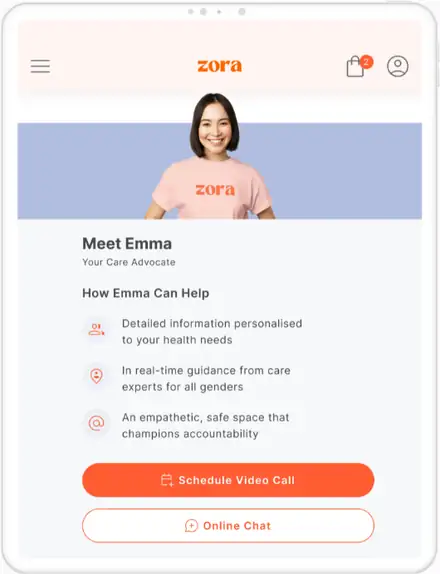
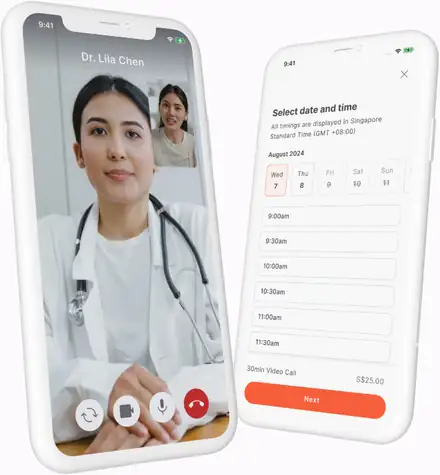
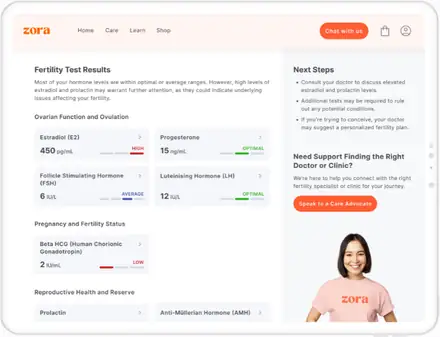
Employees join the Zora app with a company code, or single sign-on for larger teams. They can learn about fertility and egg freezing, understand what your benefit covers, book a confidential care navigation call and find partner clinics and specialists.
For HR
- Kick-off, week 1. Agree goals, countries and which employees are eligible.
- Policy and benefit design, weeks 2 to 4. Draft or update your fertility policy using our templates.
- Launch, typically weeks 4 to 6. A launch talk for employees and managers, plus a communications pack for HR to send.
- Live support. Employees book care navigation calls and use the Zora app.
- Reporting, every 3 months, on the Complete programme. Anonymised usage, common themes and our recommendations, reviewed with your account manager.
Privacy
Employee privacy is central to our programmes. On the Complete programme, routine employer reports contain aggregated engagement and utilisation information, with safeguards to prevent identification of individual employees. On every programme, personal health information is not included in standard HR reporting, and employees can get help without telling their manager. Where eligibility checks or claims administration need individual-level data, access is limited to authorised parties for defined purposes, as agreed in writing before launch. Employee data is handled in line with Singapore’s Personal Data Protection Act and the United Kingdom’s UK GDPR and Data Protection Act 2018, under which health data is special category data.
Clinics and doctors in the United Kingdom
Zora’s clinic and doctor directory does not list providers in the United Kingdom yet. It lists 421 clinics and 1,185 doctors across 25 countries, mostly in Asia Pacific and the Middle East (browse clinics or browse doctors). Employees in the United Kingdom can still use Zora’s education and the Zora app. Ask us how your team in the United Kingdom would use Zora before you launch. See Zora’s employer guides for every country.
Rules and eligibility in the United Kingdom
Who can use assisted reproduction
HFEA-licensed clinics treat couples and single people: about 3,700 single patients and 2,800 female same-sex patients had IVF in 2024 (HFEA). Same-sex couples and single women without a known fertility problem may need to self-fund insemination before NHS IVF (HFEA). NICE’s 2026 guideline (NG257) offers IVF after 12 unsuccessful cycles of artificial insemination, 6 or more of them by IUI (NICE).
Egg freezing and storage
Since 1 July 2022, people can store their own eggs, sperm or embryos for up to 55 years, renewing consent every 10 years; the usual limit was 10 years (HFEA, HFEA, egg freezing). 5,580 patients froze eggs in 2024, up from about 700 in 2014 (HFEA).
Maternity and paternity leave, and no fertility leave
From 5 April 2026, Statutory Maternity Pay is 90% of average weekly earnings for 6 weeks, then £194.32 a week (or 90% if lower) for 33 weeks (GOV.UK). Paternity leave of up to 2 weeks became a day-one right on 6 April 2026; Statutory Paternity Pay, at the same weekly rate, needs 26 weeks of service (GOV.UK, nibusinessinfo). There is no legal right to paid time off for IVF. From embryo transfer, employees have a pregnant worker’s rights, protected for 2 weeks after learning treatment failed (Acas).
Flexible work, dismissal and pregnancy loss leave
Employees can already request flexible working from day one (GOV.UK). Under the Employment Rights Act 2025 (Royal Assent December 2025), the unfair dismissal qualifying period falls to 6 months from 1 January 2027, and further flexible working changes are expected in autumn 2027 (Mishcon de Reya). From April 2027, under regulations still to be made, up to 2 weeks of unpaid day-one leave for pregnancy loss before 24 weeks will cover an unsuccessful IVF embryo transfer, for the patient and partner (UK Government, September 2026).
Discrimination law, bills and the voluntary pledge
Depending on the stage of treatment, the Equality Act 2010 may protect employees from sex or pregnancy discrimination (Burness Paull). The Fertility Treatment (Employment Rights) Bill of December 2023, for time off for appointments, fell at the end of its session (Parallel Parliament). The Fertility Treatment (Right to Time Off) Bill, a ten minute rule bill for paid time off first read on 4 November 2025 (PET BioNews), had no second reading and fell when the session ended on 29 April 2026 (UK Parliament, Parallel Parliament). The voluntary 2022 Fertility Workplace Pledge asks employers to train staff, appoint fertility ambassadors and allow flexible working for treatment (PET BioNews).
Surrogacy
Surrogacy is legal on an altruistic basis only: commercial brokering is an offence and surrogates may be paid reasonable expenses (Surrogacy Arrangements Act 1985). The surrogate is the legal mother at birth; intended parents apply for a court parental order (HFE Act 2008, s54). The Law Commission’s 2023 reforms are not a government legislative priority (Mills & Reeve, 2026). Eligible intended parents can take statutory adoption leave and pay (Acas).
Why employers choose Zora
Companies including Hilton, LinkedIn, Sanofi, HSBC, Mastercard, Carousell and Singapore Management University work with Zora Health. We work alongside your existing insurance, helping employees use the cover they already have and find suitable specialists based on their needs.
Trying to conceive with a heavy workload took a toll on my husband and me. It helped us understand our options.
Questions HR teams ask us
Is fertility leave mandatory in the United Kingdom?
No. There is no legal right to paid time off for IVF or other fertility appointments, and Acas advises treating them like other medical appointments. A private member’s bill for paid time off, introduced in November 2025, fell when the parliamentary session ended in April 2026. From embryo transfer, employees have the same rights as a pregnant worker, and from April 2027 unpaid pregnancy loss leave of up to 2 weeks will cover an unsuccessful IVF embryo transfer.
Does the NHS pay for IVF in the United Kingdom?
It depends where the employee lives. NICE recommends 3 full cycles for eligible women under 40, but English ICBs set their own rules and 29 of 42 funded only one cycle in February 2026. Scotland offers up to 3 full cycles, Wales 2 for women under 40 and Northern Ireland 1 full cycle. Criteria on age, BMI, smoking and existing children apply, and 28% of UK IVF cycles were NHS-funded in 2024.
Is egg freezing allowed in the United Kingdom, and for how long?
Yes. Since 1 July 2022, people can store their own eggs for up to 55 years if they renew consent every 10 years. Elective egg freezing is self-funded, and the HFEA puts the average cost of collection and freezing at £3,350, plus £500 to 1,500 for medication and £125 to 350 a year for storage.
Does Zora replace our health insurance?
No. Zora works alongside your insurance. We help employees understand their options, find suitable specialists and use the cover they already have.
How much does a fertility benefit cost an employer?
It depends on the allowance, eligibility and expected uptake. Use the budget planner on this page for a first estimate, then ask us for a tailored proposal based on your headcount and countries.
How quickly can we launch?
Typically 4 to 6 weeks from contract to launch, depending on scope and countries. Most companies start with a single talk.
Related guides for UK employers
Build a fertility benefit for your team
Whether you are introducing fertility benefits for the first time or improving an existing programme, tell us your headcount, countries and priorities. We will come back within two working days with suitable services, an indicative budget and a practical rollout plan for your UK team. No obligation.
Not ready to talk yet? Explore how Zora works
Sources
- ONS, Births in England and Wales: 2025 (final rates), September 2026
- HFEA, Fertility treatment 2024: trends and figures, June 2026
- HFEA, Costs and funding
- HFEA, Egg freezing
- HFEA, New law comes into force giving greater flexibility for fertility patients, July 2022
- NICE, Fertility problems: assessment and treatment (NG257), access criteria for IVF, 2026
- PET BioNews, Nearly 70 percent of ICBs in England offer only one NHS-funded IVF cycle, February 2026
- Scottish Government, NHS IVF access criteria review
- STV News, Single women and blended families could gain access to NHS-funded IVF under review, August 2026
- Fertility Network UK, NHS funding in Wales
- Department of Health Northern Ireland, Increase in funded IVF provision, February 2024
- Guy’s and St Thomas’ Specialist Care, Self-funded fertility pathway
- Salisbury NHS Foundation Trust, Fertility centre treatment prices, January 2026
- CIPD, Fertility challenges at work, May 2023
- Zurich UK, Women are hiding IVF treatment from their bosses for fear of losing their jobs, October 2022
- Acas, If they’re having IVF treatment
- GOV.UK, Maternity pay and leave: pay
- GOV.UK, Paternity pay and leave: eligibility
- nibusinessinfo.co.uk, New statutory payment rates for 2026-27
- GOV.UK, Flexible working
- Mishcon de Reya, Employment Rights Act hub, 2026
- Department for Business and Trade, Leave for bereavement including pregnancy loss: government response, September 2026
- Burness Paull, Workplace support for fertility treatment: new paid leave proposals in focus, November 2025
- PET BioNews, MP calls for paid time off for fertility treatment, November 2025
- UK Parliament, Fertility Treatment (Right to Time Off) Bill, stages
- Parallel Parliament, House of Commons, Prorogation, 29 April 2026
- Parallel Parliament, Fertility Treatment (Employment Rights) Bill 2023-24
- PET BioNews, Major employers back Fertility Workplace Pledge, November 2022
- PET BioNews, Bus company offers paid time off for IVF, March 2026
- ICO, What is special category data?
- Ferring, Fertility Matters at Work and This Can Happen, The Impact of Fertility Challenges at Work: International Insights, November 2025
- Surrogacy Arrangements Act 1985, legislation.gov.uk
- Human Fertilisation and Embryology Act 2008, section 54 (parental orders), legislation.gov.uk
- Mills & Reeve, Surrogacy law reform: are we still waiting for change?, September 2026
- Acas, Leave and pay when you have a child through surrogacy
- Ferring Pharmaceuticals, Fertility Matters at Work and This Can Happen, workplace fertility survey, November 2025
- Carrot Fertility, Global Fertility at Work report, 2023
- Gallup, This fixable problem costs US businesses $1 trillion, 2019
- World Health Organization, 1 in 6 people globally affected by infertility, April 2023
Information on this page is correct as of 5 November 2026. Laws, public funding, insurance rules and treatment costs change often, so check current rules with the relevant authority, insurer or a qualified adviser before making decisions. This page is general information, not legal, financial, tax or medical advice.