
Zora Health / Employer guide / Nigeria
Support your experienced employees through menopause, and help them stay at their best.
Hot flushes, fatigue and joint pain affect most Nigerian women around menopause, and in one hospital study one in six said symptoms stopped them carrying on with their jobs. Zora Health helps you build practical menopause support, from workplace policies and manager training to confidential care navigation and access to 128+ partner clinics in 16 countries, around your workforce and budget. Companies including Hilton, LinkedIn, Sanofi, HSBC, Mastercard, Carousell and Singapore Management University work with us.
Book an employer consultation Explore the cost calculator
Five things Nigeria HR leaders should know
- Nigerian studies put the average age at menopause at about 49.
- In a study of 402 women in southeast Nigeria, 79.6% reported hot flushes, 74.8% fatigue and 52.2% poor memory.
- In a study of 432 women in Enugu, 16.7% said symptoms left them unable to carry on with their jobs, and only a third sought medical attention.
- The NHIA Act 2022 makes health insurance mandatory, including for employers with five or more staff.
- The Labour Act gives up to 12 working days of paid sick leave a year. There is no menopause leave.
Why menopause is a business problem for employers
Menopause rarely announces itself at work. It looks like a senior manager who slept four hours, a wave of heat in the middle of a client meeting, a word that will not come in front of the board. Symptoms come and go for years. Many women do not link them to menopause, and fewer tell their manager.
So the cost stays out of your reports. It shows up instead as:
- Common symptoms. In a study of 402 women in Enugu, Abakaliki and Aba, 79.6% reported hot flushes, 74.8% fatigue, 69.6% joint pain and 68.1% anxiety (Ozumba et al., 2004).
- Concentration. In the same study, 52.2% reported poor memory, which can affect performance at work.
- Leaving work. In a study of 432 women aged 45 and over attending a clinic in Enugu, 16.7% said they were unable to carry on with their jobs because of symptoms (Ikeme et al., Annals of Medical and Health Sciences Research, 2011).
- Untreated symptoms. In the Enugu study, only 33.3% sought medical attention for their symptoms.
What employers gain
Keep the people who know how your business runs
Replacing an employee costs one-half to two times their annual salary, according to Gallup. Women’s labour force participation was about 81% in 2025, including informal work (World Bank, ILO estimate), so many of your experienced employees will go through menopause at work. A written policy, trained managers and quick access to the right doctor can help address barriers that contribute to employee attrition.
Stand out to experienced women
Few employers in Nigeria offer structured menopause support. A clear offer, explained in your benefits pack, stands out to senior women weighing their next move.
Make menopause support financially predictable
Aon projects Nigeria’s medical trend at 43.0% for 2026, or 6.0% after inflation (Aon, 2026 report). Much of what helps menopause costs very little: a flexible start time, a fan, a manager who knows what to say.
Zora helps employers set an annual allowance or top-up around your HMO or health insurance plan, so HR can run the programme within an agreed budget. The benefit works alongside your existing insurance.
Want to see what this would look like for your Nigeria workforce?
What menopause care costs, and what the state pays
Out-of-pocket payments made up 71.9% of health spending in Nigeria in 2023, so employer cover makes a large difference to whether women seek care.
| Item | Public support | What the employee still carries |
|---|---|---|
| Health insurance under the NHIA Act 2022 | Mandatory for residents; employers with five or more staff must take part | Contributions are set by state schemes, not by the Act |
| Out-of-pocket costs | About 72% of health spending is paid directly by patients | Consultations, tests and medicines not covered by the plan |
| Time off for appointments | Up to 12 working days of paid sick leave a year, with a medical certificate | No menopause leave |
From KPMG Nigeria, the World Bank and the Labour Act, section 16. We could not confirm current state contribution rates or private consultation fees. These are published examples, not guaranteed current prices: actual costs depend on cover, clinic, doctor and treatment, so confirm fees with the provider before budgeting.
One in six women in an Enugu study said menopause symptoms left them unable to carry on with their jobs.
We have found no menopause workplace law or guidance in Nigeria. For employers, the practical opportunity is to help employees recognise their symptoms, understand their options and reach appropriate clinical advice sooner.
Menopause support that fits your workforce and budget
You do not need to overhaul your existing health insurance to support employees through menopause. Start with awareness and manager education, add confidential one-to-one support, or introduce a fuller programme across your offices. There is no minimum company size.
Where included in the employer programme, eligible employees can use talks and care navigation without paying Zora a separate fee. Care navigation allowances are set in each proposal. Treatment and other third-party costs are paid separately, either by employees or through the allowance their employer provides.
Companies starting the conversation
Essentials
Expert-led talks for employees and managers, menopause policy templates, manager guides and full access to the Zora app. Up to 2 talks a year.
Employees supported one to one
Navigation
Everything in Essentials, plus confidential one-to-one care navigation and access to our partner clinic network.
Large teams across countries
Complete
Everything in Navigation, plus quarterly anonymised reporting, a dedicated account manager and scheduled review meetings with HR.
Optional add-ons can be added to any programme, subject to availability: hormone diagnostics and telehealth with specialists. Pricing is tailored to your headcount, your countries and the services you choose. Most companies start with a single talk.
Request a proposal See how Zora works for employers
Comparing menopause benefit providers? Use our RFP question bank
Our question bank has 40 questions for multi-country benefits teams, with why each one matters, what a good answer looks like and a scoring sheet for three providers. Six of the questions for menopause support in Nigeria:
- Is menopause support included as standard, or only fertility?
- What access do employees get to menopause specialists and hormone testing, and how quickly?
- How does the programme work alongside our HMO plan and the state scheme under the NHIA Act, without duplicating cover?
- Do you provide fertility and menopause policy templates for our markets?
- How can an employee get help confidentially without telling their manager?
- What individual-level data does HR see?
Your download link appears as soon as you submit. Zora Health may contact you about employee benefits; see our privacy policy.
Plan your menopause benefit budget
Menopause care allowance planner
Model the annual claims budget for a menopause care allowance. Change any number.
This is a claims budget, not a Zora quotation. Zora’s programme fees, implementation and optional services are separate.
It estimates the annual budget for a menopause care allowance from your eligible workforce, expected utilisation and allowance per employee, and assumes each user claims the full allowance. Eligible employees defaults to 15% as a stand-in for women aged 45 and over; use your own headcount data. The default allowance of NGN 150,000 is an illustrative figure for private consultations, tests and treatment. Utilisation is an editable assumption, not observed Zora data. For a proposal covering both programme costs and employee benefits, request an employer proposal.
Estimate the potential workforce impact of menopause symptoms
A rough planning scenario. It applies a published estimate to your headcount, so it is not a prediction for your workforce, a measured loss or a forecast of savings from any programme.
Range: NGN 3,346,650 to NGN 10,130,400 a year, depending on replacement cost.
Assumptions: 13.4% of working women aged 45 to 60 reported at least one adverse work outcome due to menopause symptoms, and those who missed work lost a median of 3 days a year (Faubion et al., Mayo Clinic Proceedings, 2023). This was a US clinic sample, so treat it as a rough benchmark for Nigeria. The default salary is an illustrative figure for corporate employees. There is no official average salary figure, so use your own. Replacing an employee costs one-half to two times their annual salary (Gallup, 2019); the headline uses the low end. Absence is valued at salary divided by 250 working days. Exit rate is your own assumption.
Already have corporate health insurance? Here is where Zora fits
Your medical plan may cover some consultations and treatment. Employees still need to recognise their symptoms, understand their options and find a doctor who knows menopause care, and many never get that far.
Zora works alongside your existing insurance and benefits. We help employees get reliable information, navigate their care options and reach suitable specialists, and we give HR manager training, policy templates and, on the Complete programme, anonymised reporting. You strengthen menopause support without replacing your medical plan.
How Zora works
For your employees
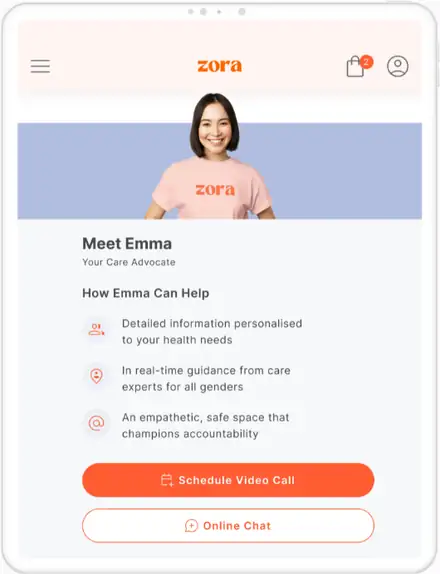
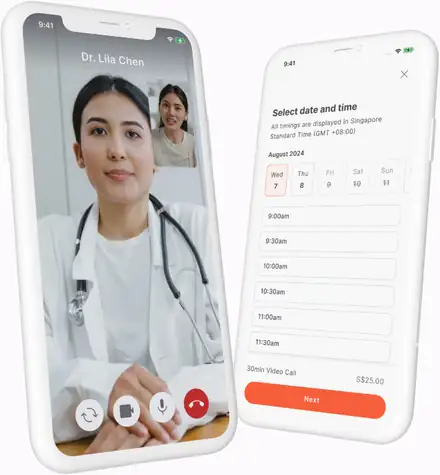
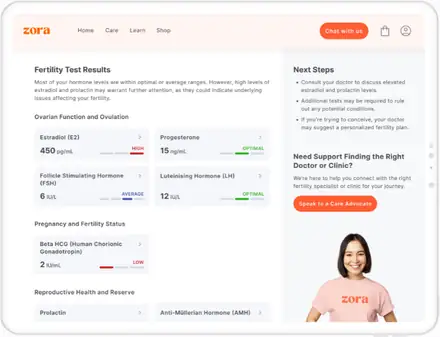
Employees join the Zora app with a company code, or single sign-on for larger teams. They can learn about perimenopause and menopause, understand what your benefit covers, book a confidential care navigation call and find partner doctors and specialists.
For HR
- Kick-off, week 1. Agree goals, countries and which employees are eligible.
- Policy and benefit design, weeks 2 to 4. Draft or update your menopause policy and flexible work guidance using our templates.
- Launch, typically weeks 4 to 6. A launch talk for employees and managers, plus a communications pack for HR to send.
- Live support. Employees book care navigation calls and use the Zora app.
- Reporting, every 3 months, on the Complete programme. Anonymised usage, common themes and our recommendations, reviewed with your account manager.
Privacy
On the Complete programme, HR receives anonymised, aggregated reports only: how many employees used the programme, which services they used and the common themes. On every programme, HR never sees an individual employee’s health information, bookings or test results, and employees can get help without telling their manager. Employee data is stored on Amazon Web Services in Singapore and handled in line with Singapore’s Personal Data Protection Act.
Clinics and doctors in Nigeria
Zora’s clinic and doctor directory does not list providers in Nigeria yet. It lists 421 clinics and 1,185 doctors across 25 countries, mostly in Asia Pacific and the Middle East (browse clinics or browse doctors). Employees in Nigeria can still use Zora’s education and the Zora app. Ask us how your team in Nigeria would use Zora before you launch. See Zora’s employer guides for every country.
Rules and eligibility in Nigeria
Sick leave
Section 16 of the Labour Act entitles a worker to wages for up to 12 working days a year of absence through temporary illness certified by a registered medical practitioner. There is no menopause leave.
National Health Insurance Authority Act
The Act requires every resident to obtain health insurance and covers employers and employees in organisations with five or more staff. Contribution rates are set by state health insurance schemes (KPMG Nigeria, June 2022).
No menopause workplace rules
We have found no menopause-specific workplace law or guidance in Nigeria. A written company policy is the clearest way to set expectations for managers.
Why employers choose Zora
Companies including Hilton, LinkedIn, Sanofi, HSBC, Mastercard, Carousell and Singapore Management University work with Zora Health. We work alongside your existing insurance, helping employees use the cover they already have and find suitable doctors and specialists based on their needs.
Zora Health helped me to reclaim my confidence to thrive at work!
Questions HR teams ask us
Do employers in Nigeria have to give menopause leave?
No. There is no menopause leave. Employees use sick leave, annual leave or flexible arrangements unless their employer offers more.
How much sick leave do employees get?
The Labour Act gives up to 12 working days a year of paid sick leave, with a medical certificate.
Do Nigerian employers have to provide health insurance?
The NHIA Act 2022 makes health insurance mandatory, including for employers with five or more staff. State schemes set contribution rates.
How common are menopause symptoms in Nigeria?
In a study of 402 women in southeast Nigeria, 79.6% reported hot flushes and 74.8% fatigue.
At what age do Nigerian women reach menopause?
Nigerian studies put the average at about 49.
Does Zora replace our health insurance?
No. Zora works alongside your insurance. We help employees understand their options, find suitable specialists and use the cover they already have.
How much does menopause support cost an employer?
It depends on the programme, any allowance and expected uptake. Use the budget planner on this page for a first estimate, then ask us for a tailored proposal based on your headcount and countries.
How quickly can we launch?
Typically 4 to 6 weeks from contract to launch, depending on scope and countries. Most companies start with a single talk.
Related guides for Nigeria employers
Build a menopause support programme for your team
Whether you are introducing menopause benefits for the first time or improving an existing programme, tell us your headcount, countries and priorities. We will come back within two working days with suitable services, an indicative budget and a practical rollout plan for your Nigeria team. No obligation.
Sources
- Adefuye et al., Menopause in Sagamu, Southwest Nigeria, East African Medical Journal, 2017 (402 women)
- Ozumba et al., Age, symptoms and perception of menopause among Nigerian women, 2004 (402 women)
- Ikeme et al., Annals of Medical and Health Sciences Research, 2011 (432 women)
- World Bank, Female labour force participation (ILO modelled estimate), 2025
- World Bank, Out-of-pocket expenditure, 2023
- KPMG Nigeria, Commentary on the National Health Insurance Authority Act 2022
- Labour Act, section 16
- Aon, Global Medical Trend Rates Report 2026
- Gallup, This fixable problem costs US businesses $1 trillion, 2019
- Mayo Clinic News Network, Faubion et al., Impact of menopause symptoms on women in the workplace, Mayo Clinic Proceedings, April 2023